
Forget Coding: Why Your Kid Needs to Learn to Train a Robot Instead
The Evolution of Mind: Why AI Isn't Making Children Smarter, It's Redefining Intelligence
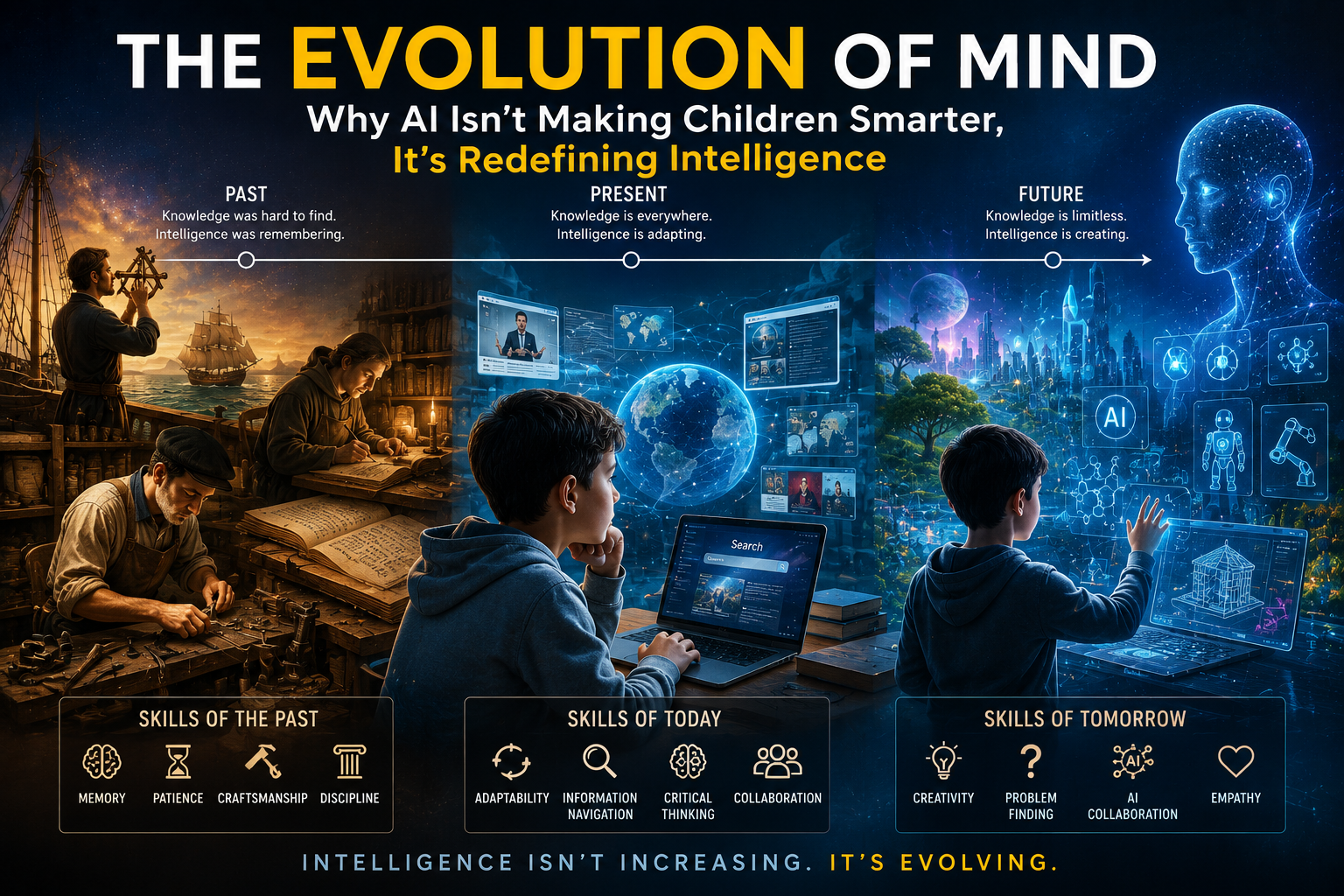
A thousand years ago, human intelligence wore a completely different face.
A skilled navigator could traverse vast, unpredictable oceans using nothing but the positioning of the stars. A master craftsman spent half a lifetime perfecting the microscopic nuances of a single trade. A scholar might dedicate their entire biological existence to collecting and transcribing a body of knowledge that today fits effortlessly onto a microscopic flash drive nestled in your pocket.
Intelligence has never been a static baseline. It is a fluid, adaptive phenomenon. Every single generation develops, sharpens, and rewards the exact skills required to survive and dominate its specific environment.
Today, that environment is shifting beneath our feet faster than at any other point in human history.
Artificial intelligence, instantaneous global connectivity, and omnipresent digital realities are not just changing the tools children use—they are rewiring how children learn, communicate, process information, and solve complex problems. The result will not necessarily be a generation that possesses a higher collective IQ in the traditional sense. Instead, it will be a generation that becomes intelligent in ways humanity has never seen before.
1. Environmental Imperatives: The Architecture of Survival
To understand why minds are changing, we must look at how environments dictate capability. Consider a simple cross-generational thought experiment:
The 1825 Paradigm (The Industrial/Agrarian Mind) | The 2025 Paradigm (The Digital/Algorithmic Mind) |
Driven by physical endurance, deep localized expertise, and spatial memory. | Driven by cognitive agility, abstract synthesis, and systemic awareness. |
Survival Skills: Agricultural literacy, mechanical repair, manual navigation, text-based memorization. | Survival Skills: Algorithmic filtering, digital defense, prompt mechanics, continuous upskilling. |
Scarcity: Information was rare, precious, and highly centralized. | Scarcity: Attention and focus are rare, precious, and highly fragmented. |
If you were to drop a modern teenager into the year 1825, they would likely struggle to survive. They could not farm, track game, or repair tools by hand. Conversely, if you transported an ordinary child from 1825 into the modern landscape, the psychological bombardment of smartphones, decentralized finance, and automated intelligences would be entirely paralyzing.
Neither child is inherently superior in raw intellect. Both are optimized biological responses to their external realities. The contemporary world no longer demands the storage of static facts; it demands the orchestration of dynamic systems.
2. From Curation to Navigation: The Death of Fact-Hoarding
For millennia, the ultimate bottleneck to human achievement was access. If you wanted to master a discipline, your path was rigidly linear and gatekept by physical infrastructure. Information flowed slowly through exclusive channels:
Step 1: The Expert Teacher (The localized source of mastery)
Step 2: The Rare Text (Handcrafted or strictly gatekept volumes)
Step 3: The Physical Library (A localized depository requiring travel)
Step 4: The Student (The final recipient of the scarce asset)
Knowledge was valuable precisely because it was scarce. Memorization was the ultimate competitive advantage; the person who retained the most data was functionally the most capable leader, advisor, or strategist.
Today, that bottleneck has completely collapsed. Before a modern child finishes their breakfast, they can watch a real-time rendering of a volcanic eruption, stream a specialized advanced lecture from MIT, interact with a three-dimensional model of Mars, and cross-examine a customized AI tutor.
Consequently, remembering information has dropped precipitously in economic and practical value. The new premium skill is information filtering.
Modern children are not information warehouses; they are information navigators. They do not store data; they direct its flow. Critics often misinterpret their rapid jumping between video essays, community threads, digital simulations, and generative models as a symptom of attention deficit. In reality, it is the birth of an advanced, non-linear literacy:
Heuristic Verification: Triangulating truth across contradictory, unverified digital sources.
Dynamic Exploration: Following conceptual threads natively rather than sticking to a rigid, top-down curriculum.
Synthesized Execution: Merging diverse media formats into immediate, actionable solutions.
3. The New Metric: Learning Velocity Over Static Memory
In a world where industry lifecycles are compressed from decades into months, static knowledge acts less like an asset and more like an anchor. Entire professional sectors now materialize, mature, and become obsolete within a single decade.
The strategic imperative has shifted from what you know to how fast you can integrate what you don't know.
To conceptualize this, think of human capability as a balance between two competing factors:
Retained Knowledge: This represents static facts. In the modern era, it decays quickly (at an estimated 15% reduction in relevance per time period) as technology and industries shift out from under us.
Adaptive Capacity: This represents your learning velocity. Unlike static facts, an individual's capacity to learn and adapt scales exponentially over time as they master new tools and workflows.
The future completely devalues the static bucket and exponentially rewards the adaptive one. The modern elite will be those who can learn, unlearn, and relearn at hyper-speed.
Children raised alongside fluid digital interfaces are innately primed for this reality. They don't read operational manuals; they test boundaries, observe feedback loops, analyze failures in real-time, and adapt on the fly. This constant exposure to evolving software, interactive platforms, and complex digital ecosystems transforms adaptability from an occasional effort into a core cognitive reflex.
4. The AI Inversion: Elevating the Purely Human
Perhaps the most profound disruption caused by artificial intelligence is the complete inversion of what constitutes visible intelligence. Historically, we measured intellect by the output of answers:
How fast can you calculate this equation?
How accurately can you recall this legal precedent?
How cleanly can you write this block of standard code?
Artificial intelligence executes all of these tasks instantly, perfectly, and at zero marginal cost. When answers become a commoditized, free utility, the economic and cultural value of the human mind shifts backward to the origin point: The Question.
AI can generate ten thousand highly articulate answers in seconds, but it remains fundamentally blind to the human context required to determine which question actually matters. The intelligence of the future is shifting away from execution and moving squarely into the realm of higher-order cognitive design:
The Human Input: Deep Curiosity & Intentional Inquiry
The Machine Interface: Strategic Prompt Mechanics
The Automated Engine: High-Velocity AI Generation
The Human Guardrail: Epistemic & Critical Judgment
The attributes that will define the elite minds of the upcoming generation are unapologetically human:
Hypothesis Design: The ability to construct powerful, unexpected queries that unlock latent machine intelligence.
Epistemic Judgment: The critical capacity to spot subtle bias, hallucinations, and structural flaws in automated outputs.
Cross-Disciplinary Synthetics: Combining art, philosophy, and hard science to create novel solutions that data-driven algorithms cannot anticipate.
Empathic Communication: Translating technical processing into profound, human-centric narratives that drive emotional alignment and action.
5. The Sovereign Threat: Cognitive Atrophy vs. Amplification
This transition is not without deep, systemic risk. The luxury of ubiquitous technology threatens to create a stark cognitive divide.
If an algorithm can generate an essay instantly, a child may never discover the agonizing, beautiful process of clarifying their own thoughts through the act of writing. If machine models provide immediate answers to every logical friction point, the cognitive muscle required to endure deep frustration and prolonged problem-solving may begin to atrophy.
Technology does not automatically democratize enlightenment. It acts as an absolute force multiplier for whatever intent it is fed:
The Passive Path: Using AI as a cognitive crutch, leading to intellectual dependence, fractured attention, and superficial understanding.
The Active Path: Using AI as a cognitive bicycle, leveraging automation to bypass mechanical tasks and accelerate into deep creativity, systemic thinking, and grand-scale execution.
The ultimate objective of modern development must never be to replace human thought. It must be to amplify it to its absolute limits.
6. The Frontier Mind
When we argue over whether children today are smarter than their predecessors, we are arguing over an outdated rubric.
Human intelligence is not an unchanging prize to be preserved in a glass case; it is a living, evolving landscape. The coming generation will not think the way we do. They will not map problems using our linear strategies, nor will they value the static milestones that defined our own intellectual development.
They are building a different architecture of mind because they are inheriting a radically different universe.
The defining question of our era is no longer how much information we can force into a child's mind. The true question is whether we can cultivate the curiosity, the resilience, and the critical framework they need to command the vast intellectual firestorms they are about to inherit.