When most people think about robotics, they immediately think about coding.
After all, robots need programs to move, respond, and complete tasks.
But here's something that surprises many parents:
Coding is only half of robotics.
Building a robot involves much more than writing lines of code.
A Robot Needs More Than a Program
Imagine writing the perfect program for a robot.
The code is flawless.
Every instruction is correct.
But what if the robot can't "see" where it's going?
Or doesn't know when it has reached an obstacle?
Without sensors and electronics, even the smartest code won't help.
Robotics is where software meets the physical world.
The Brain Is Only One Part
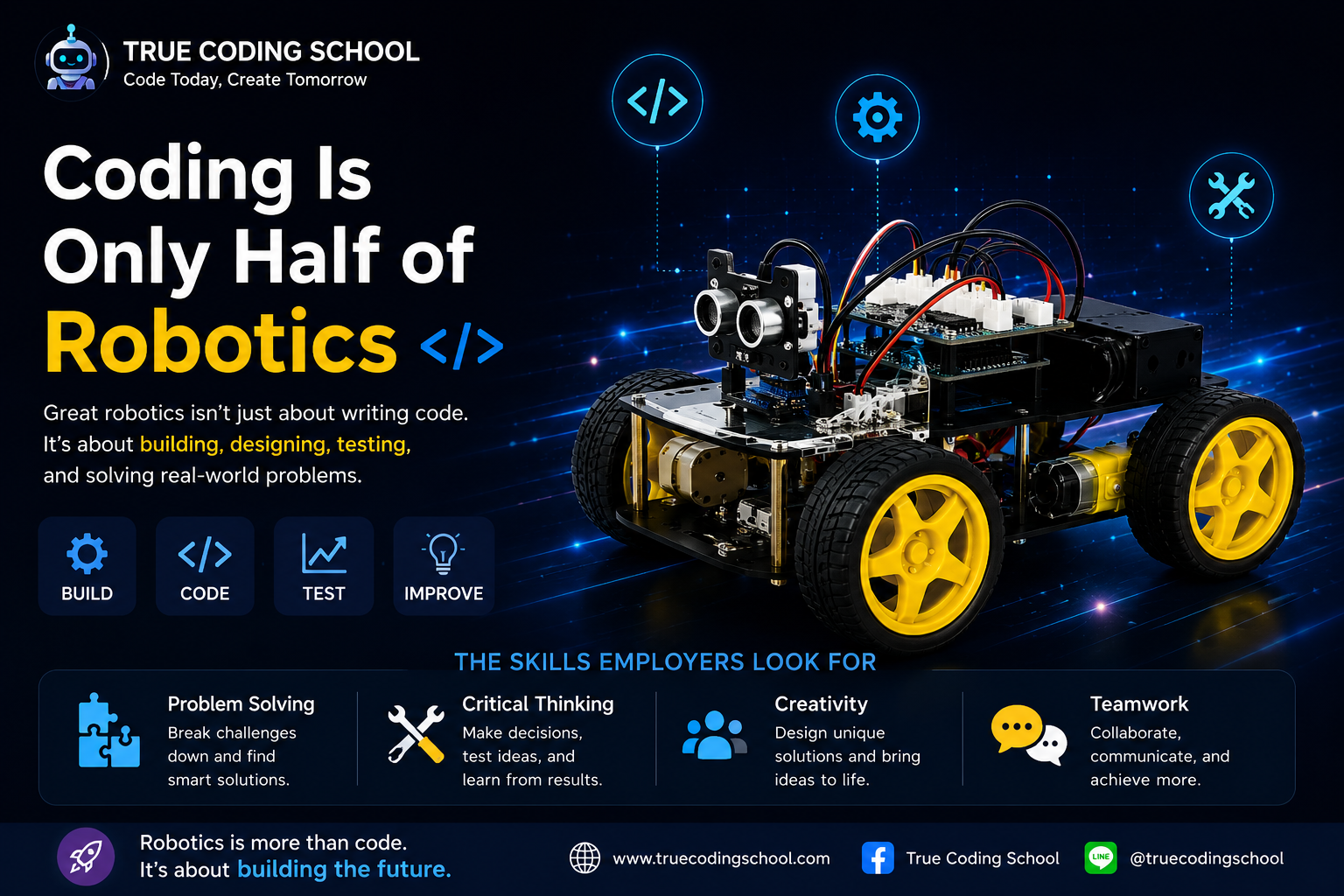
A robot is made up of several important components working together.
🧠 The Brain – A microcontroller processes information and runs the program.
👀 The Senses – Sensors allow the robot to detect light, distance, temperature, sound, or movement.
⚙️ The Muscles – Motors and servos make the robot move.
🔋 The Power – Batteries provide the energy needed to bring everything to life.
Programming tells the robot what to do—but the hardware determines what it can do.
Learning by Building
One of the reasons robotics is such a powerful learning experience is that children quickly discover that solving a problem often requires more than fixing the code.
Maybe the sensor isn't positioned correctly.
Maybe the motor needs a different speed.
Maybe the wiring isn't connected properly.
Students learn to observe, test, adjust, and try again.
This process develops logical thinking, patience, and resilience—skills that extend far beyond robotics.
Engineering in Action
Unlike traditional programming, robotics allows students to see their ideas come to life in the real world.
A few lines of code can make a robot follow a line.
A distance sensor can help it avoid obstacles.
A simple button can trigger an entire sequence of actions.
Children begin to understand how software and hardware work together to solve real-world problems.
Preparing for Tomorrow's Technology
Many of today's fastest-growing industries combine programming with electronics.
From autonomous vehicles and smart homes to industrial automation and medical devices, modern technology depends on both software and hardware working together.
Learning robotics gives students an early introduction to these real-world engineering concepts through fun, hands-on projects.
More Than Just Coding
At True Coding School Phuket, robotics is about much more than teaching children how to write code.
Students explore programming, electronics, sensors, motors, and microcontrollers while building projects that encourage creativity, experimentation, and problem-solving.
Because great robots aren't built with code alone.
They're built with curiosity, engineering, and the confidence to turn ideas into reality.