
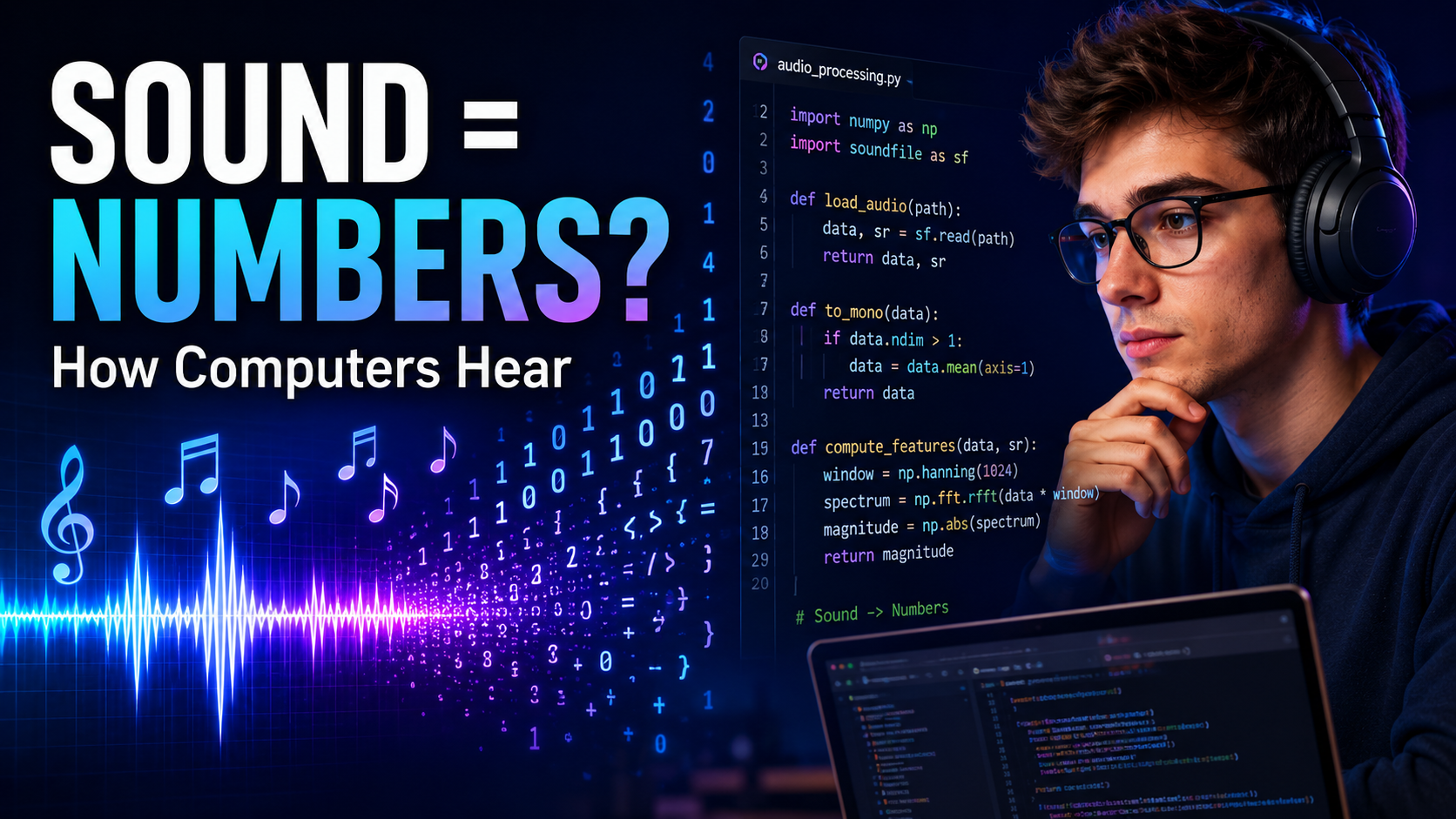
Imagine listening to your favorite song. Maybe it's a track by Taylor Swift, an anthem by Imagine Dragons, or the nostalgic, ambient background score of Minecraft or Roblox. You hear the breath in a singer's vocals, the punch of a bass drum, the crunch of an electric guitar, and the delicate ring of a piano. The music feels completely, undeniably alive. It has the power to make you dance, laugh, cry, or instantly transport you back to a memory from years ago.
But here is a fundamental truth of the modern world that sounds utterly impossible: Your computer, smartphone, and headphones have never actually heard a single note of music. Not once.
To a machine, your favorite track isn’t an artistic arrangement of sound waves or emotions. It is an unimaginably massive, precisely ordered sequence of numbers. And when you realize how those numbers become the art that moves you, it changes how you look at the digital world forever.
🎵 Wait... Music Is Just Numbers?
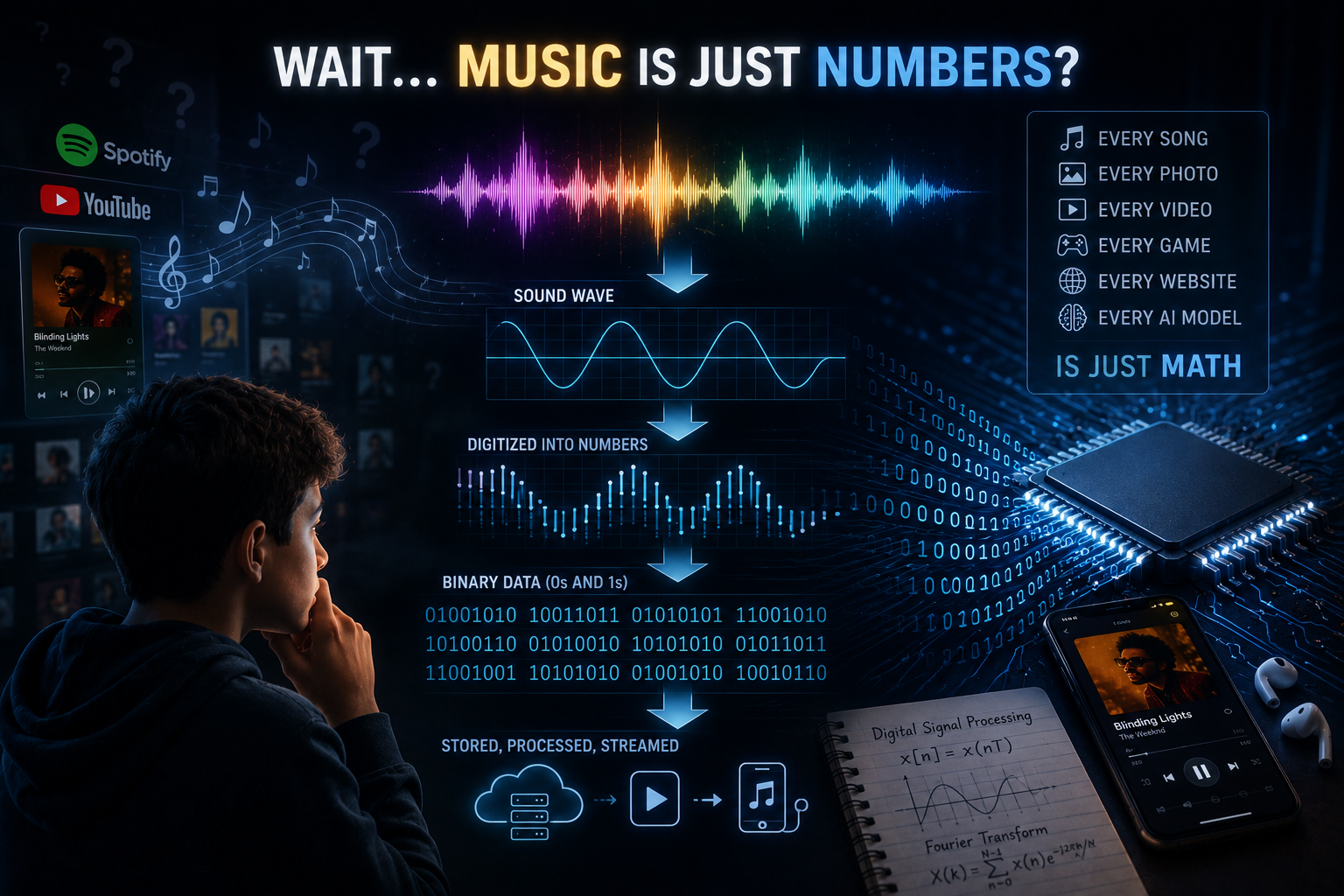
How does Spotify store an entire library of human expression? How does YouTube stream flawless music videos to your screen? How can your phone hold tens of thousands of tracks inside a microscopic silicon chip that fits effortlessly into your pocket?
Most people subconsciously imagine that somewhere inside the hardware, there is a miniature, invisible vinyl record spinning away, or a tiny cassette tape tracking along. But computers have no ears, and they have no concept of sound. A computer does not understand melodies, chord progressions, human vocal cords, or raw emotion.
Computers only understand one thing: binary data represented as numbers. Everything you interact with online eventually boils down to mathematics. Every crisp photo you take, every high-definition video you stream, every 3D world you explore in a video game, every website you browse, every advanced AI model and yes, every single song you love is just math in disguise.
〰️ Music Begins As Vibrations (The Physics)
Before music can be digitized into data, it has to exist in the physical world. And in the physical world, music is pure physics.
When a singer performs, their vocal cords vibrate. When a drummer strikes a snare, the drum skin vibrates. When a guitarist plucks a wire, the string vibrates. These physical objects push and pull against the air molecules around them, creating localized changes in air pressure. These variations travel through space as longitudinal waves, known to us as sound waves.
Your ears possess delicate membranes that detect these pressure waves, translating them into electrical impulses that travel to your brain. Your brain then interprets those signals as sound. Music, at its core, is simply a beautifully organized symphony of physical vibrations traveling through the air.
The Great Digital Dilemma
Humans are organically wired to perceive these continuous, fluid waves of air pressure. Computers, however, are static. A computer cannot look at a continuous, smoothly flowing wave and log it perfectly because a wave has an infinite number of points along its path. To a machine, infinity is a problem.
To solve this, computer scientists use a technique called Sampling. Instead of trying to record the entire, infinite wave, the computer takes rapid digital snapshots of the wave's height at exact intervals.
Imagine taking a photograph of a running athlete every few fractions of a second. A single photograph doesn't show the whole run, but if you flip through thousands of those photographs rapidly, you see the exact movement of the runner. Computers do the exact same thing with sound. They measure the wave over and over again thousands of times every single second.

🧮 The Mathematics: How Sound Becomes Data
To turn a physical, analog wave into clean digital numbers, computer engineers rely on a fundamental piece of mathematics known as the Nyquist-Shannon Sampling Theorem. The core rule is beautiful in its simplicity: to perfectly capture a sound that humans can hear, you must sample it at a rate that is at least twice the highest frequency of human hearing.
Since the upper limit of human hearing is roughly 20,000 Hertz (20,000 vibrations per second), high-fidelity digital audio must be sampled at a baseline rate of over 40,000 times per second. This is why standard CD-quality audio captures sound exactly 44,100 times every single second (44.1 kHz).
To calculate the exact value of a sound wave at any microscopic slice of time, engineers use a basic function where amplitude is mapped against time:
Where:
represents the exact microsecond we are measuring.
is the mathematical function describing the continuous analog sound wave.
is the resulting numerical value representing exactly how high (loud) or low (quiet) the wave is at that split second.
When a computer samples a song at 44.1 kHz, it generates 44,100 numbers for just one second of audio. For a standard three-minute pop song, that translates to:
What a Song Looks Like to You vs. Your Phone
When you look at a track, your brain interprets art. When your device processes that exact same track, it sees an unyielding column of data:
What Your Brain Experiences 🧠 | What Your Computer Actually Reads 💻 |
🎵 A soft, ambient intro |
|
🎸 The guitar string begins to vibrate |
|
🎤 The lead singer hits a soaring note |
|
🥁 A massive, powerful bass drum hit |
|
When you hit the "Play" button on your phone, a chip called a Digital-to-Analog Converter (DAC) reads these millions of numbers sequentially at the exact same speed they were recorded. It translates those numbers back into precise electrical voltages, sending them to your headphones. The magnets inside your headphones move back and forth according to those numbers, physically pushing the air to recreate the original sound waves.
The emotional ballad vibrating in your ears is literally being computed and rebuilt in real time from mathematical instructions.
🧠 The Mind-Blowing Connection: Audio, Photos, and AI
Here is where the true beauty of computer science reveals itself: your favorite song is made entirely of numbers, but so is everything else in our digital universe.
The exact same building blocks used to create audio are rearranged to create every other piece of technology you interact with daily:
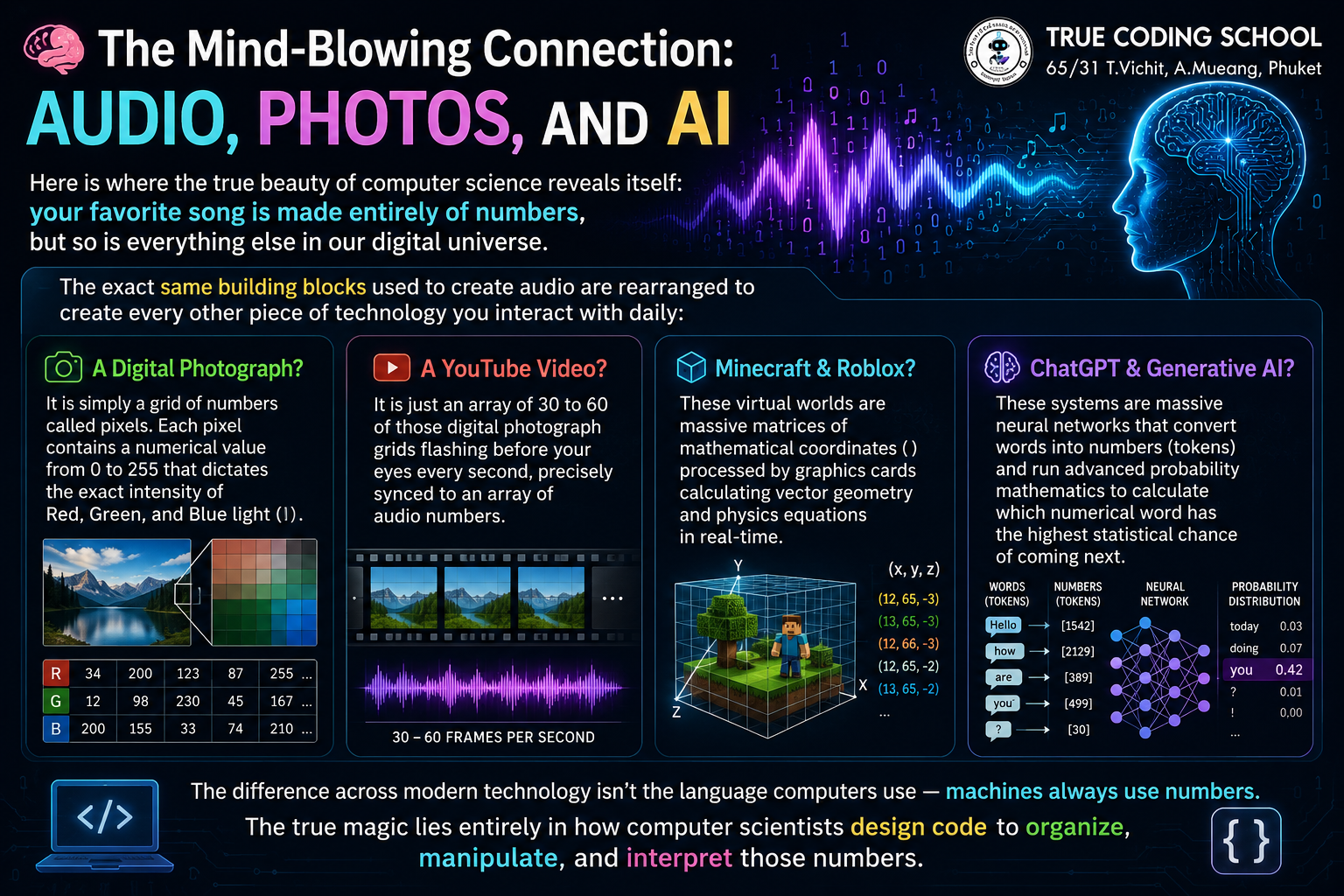
A Digital Photograph? It is simply a grid of numbers called pixels. Each pixel contains a numerical value from
0to255that dictates the exact intensity of Red, Green, and Blue light ().A YouTube Video? It is just an array of 30 to 60 of those digital photograph grids flashing before your eyes every second, precisely synced to an array of audio numbers.
Minecraft & Roblox? These virtual worlds are massive matrices of mathematical coordinates () processed by graphics cards calculating vector geometry and physics equations in real-time.
ChatGPT & Generative AI? These systems are massive neural networks that convert words into numbers (tokens) and run advanced probability mathematics to calculate which numerical word has the highest statistical chance of coming next.
The difference across modern technology isn't the language computers use machines always use numbers. The true magic lies entirely in how computer scientists design code to organize, manipulate, and interpret those numbers.
🏫 From Passive Users to Digital Architects
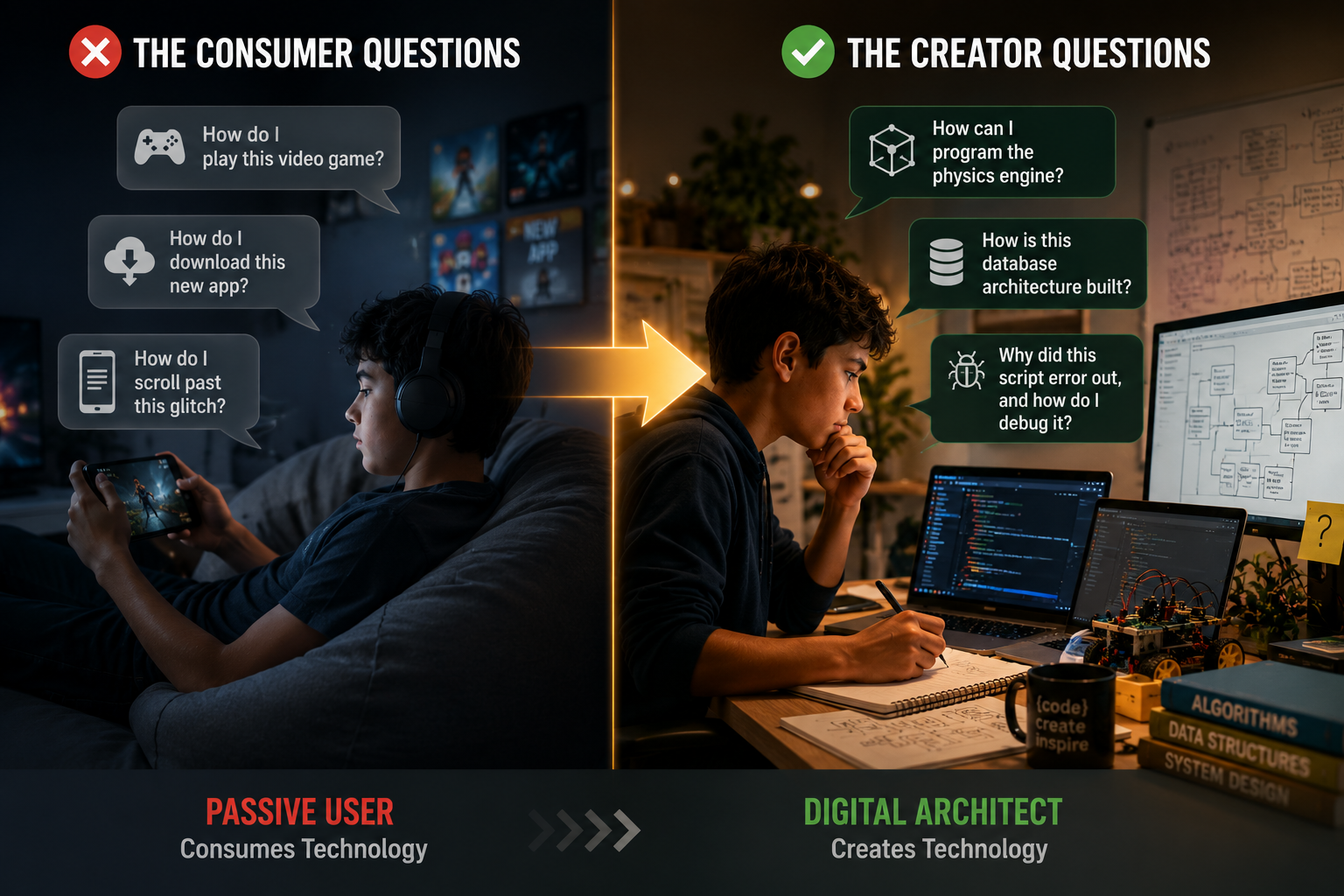
One of the most profound breakthroughs a young student can experience is the realization that technology is not magic. It feels like magic when you don't understand it, but underneath the glass screen, it is a beautifully logical world built on mathematics, structured engineering, and human creativity.
When students at True Coding School Phuket discover this secret, their entire relationship with technology undergoes a radical transformation. They stop looking at devices as passive entertainment systems and begin viewing them as canvases for creation.
🚀 Unlock Your Child's Creative Potential
At True Coding School Phuket, we don't believe in boring lectures, rote memorization, or forcing children to copy-paste dry code from a textbook. We dive deep into Project-Based Learning, guiding students to discover exactly how computers process data, how game engines calculate real-time logic, and how modern software is engineered from the ground up.
Once a child understands the logical, numerical reality hidden behind the screen, they break free from the loop of passive consumption. They gain the confidence, analytical thinking, and structural problem-solving skills required to become the tech builders, creators, and innovators of tomorrow.
Let's give your child the tools to stop just using the future, and start building it.
📋 Contact Information
Channel | Details |
📞 Phone | |
💬 Line |
|
📍 Address | 65/31 Moo 2, Chaofa-Suanluang Road, Vichit, Muang, Phuket 83000, Thailand |