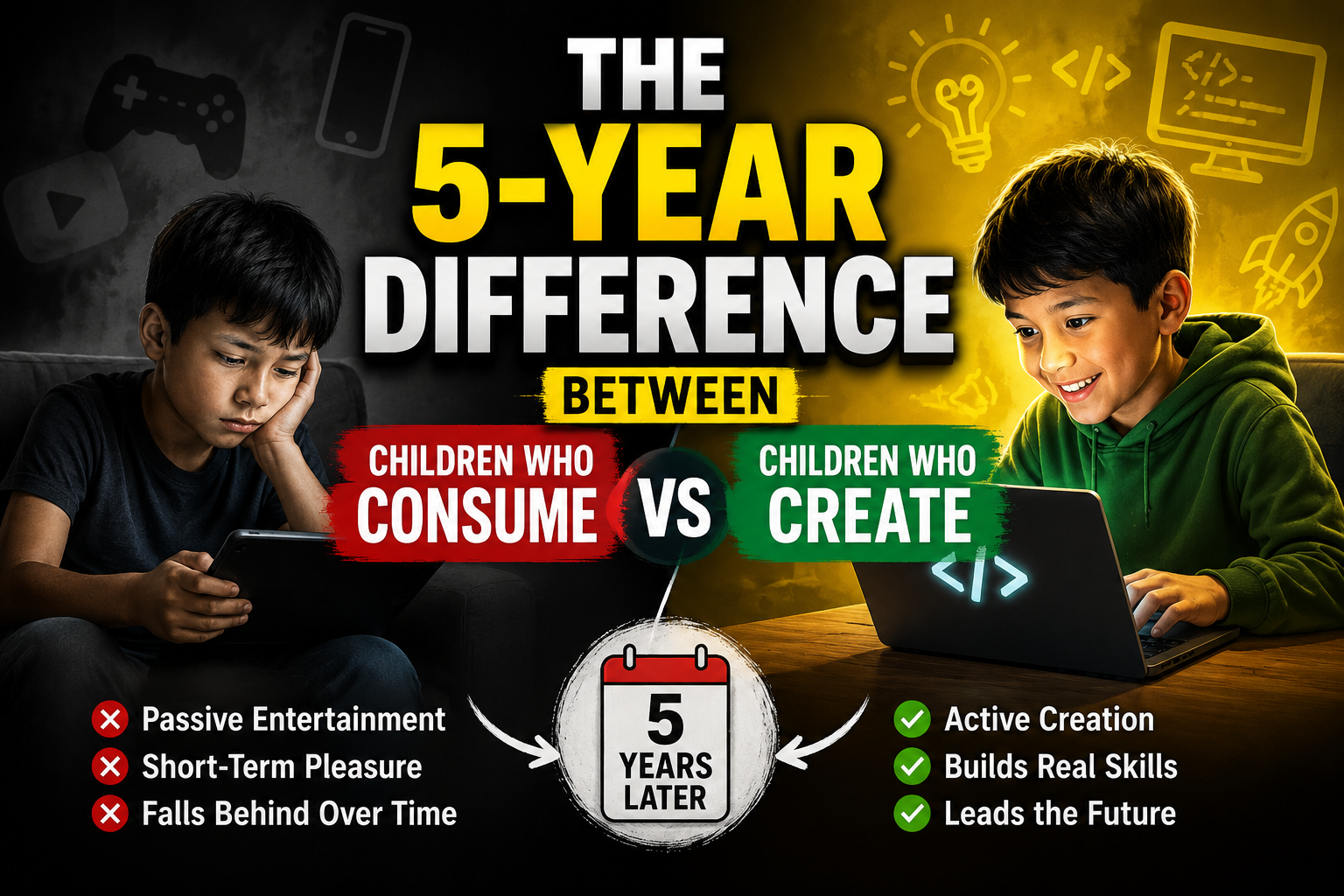
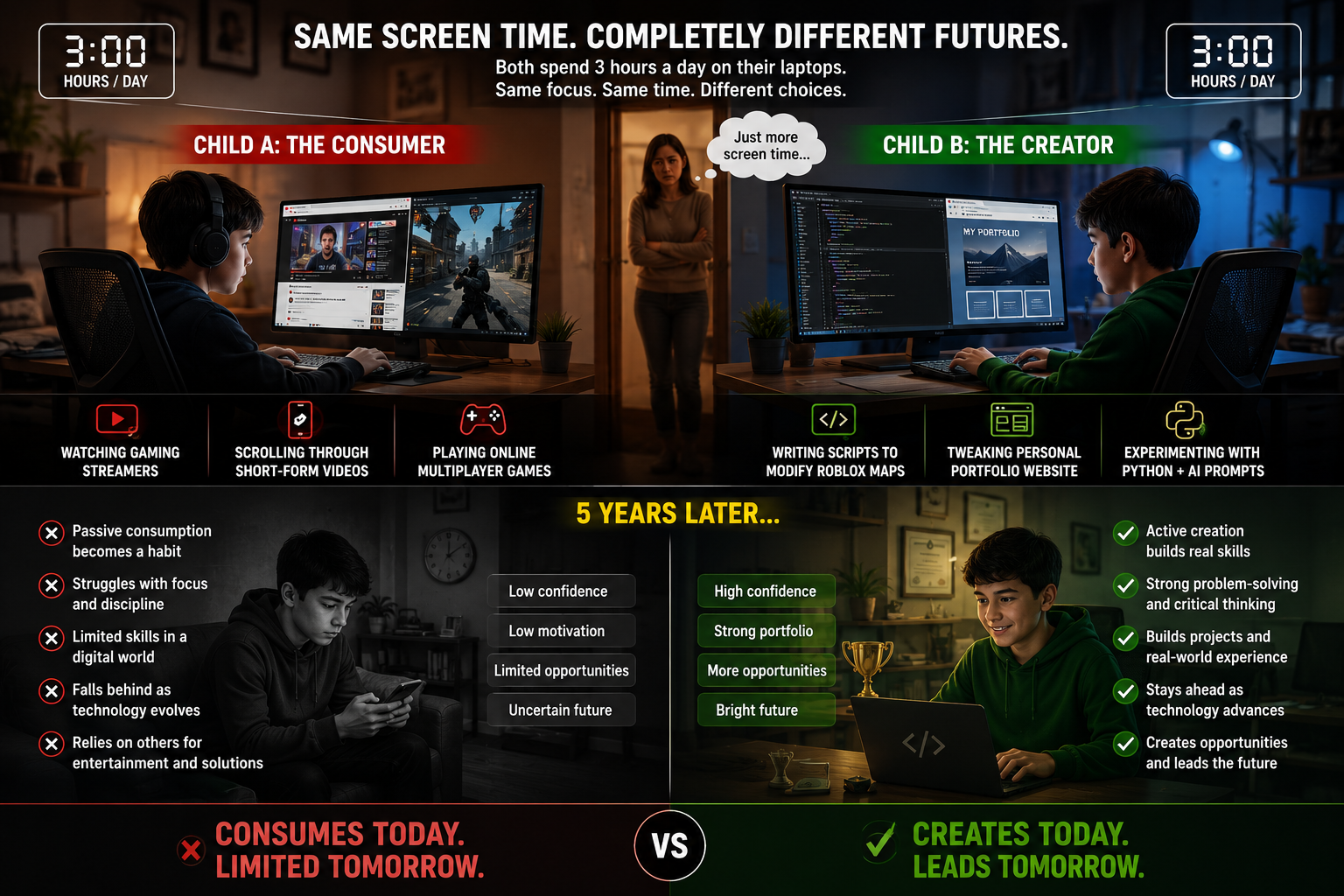
Imagine two 10-year-old children sitting side by side in identical chairs. Both spend exactly three hours a day on their laptops.
From the outside, they look completely indistinguishable. Both are deeply focused, eyes locked on the glowing displays, fingers clicking away in a state of absolute immersion. A parent walking past the doorway sighs, assuming both are simply losing themselves to "screen time."
But look closer at what is actually happening behind the glass:
Child A (The Consumer): Is watching a gaming streamer on YouTube, scrolling through a short-form video feed, and playing rounds of an online multiplayer game.
Child B (The Creator): Is writing a custom script to modify a Roblox map, tweaking the layout of a personal portfolio website, and experimenting with a basic Python loop to feed prompts into an AI model.
To the casual observer, their present reality is exactly the same. But if you fast-forward five years into the future, the divergence between these two children will be absolutely staggering. Here is what that 5-year gap actually looks like, and why the hidden difference between digital consumption and digital creation dictates a child's entire future.
👥 The 5-Year Horizon: A Side-by-Side Comparison
By the time both children reach the age of 15, the hidden compounding interest of how they spent their screen time becomes blindingly obvious.
The Consumer’s Ceiling
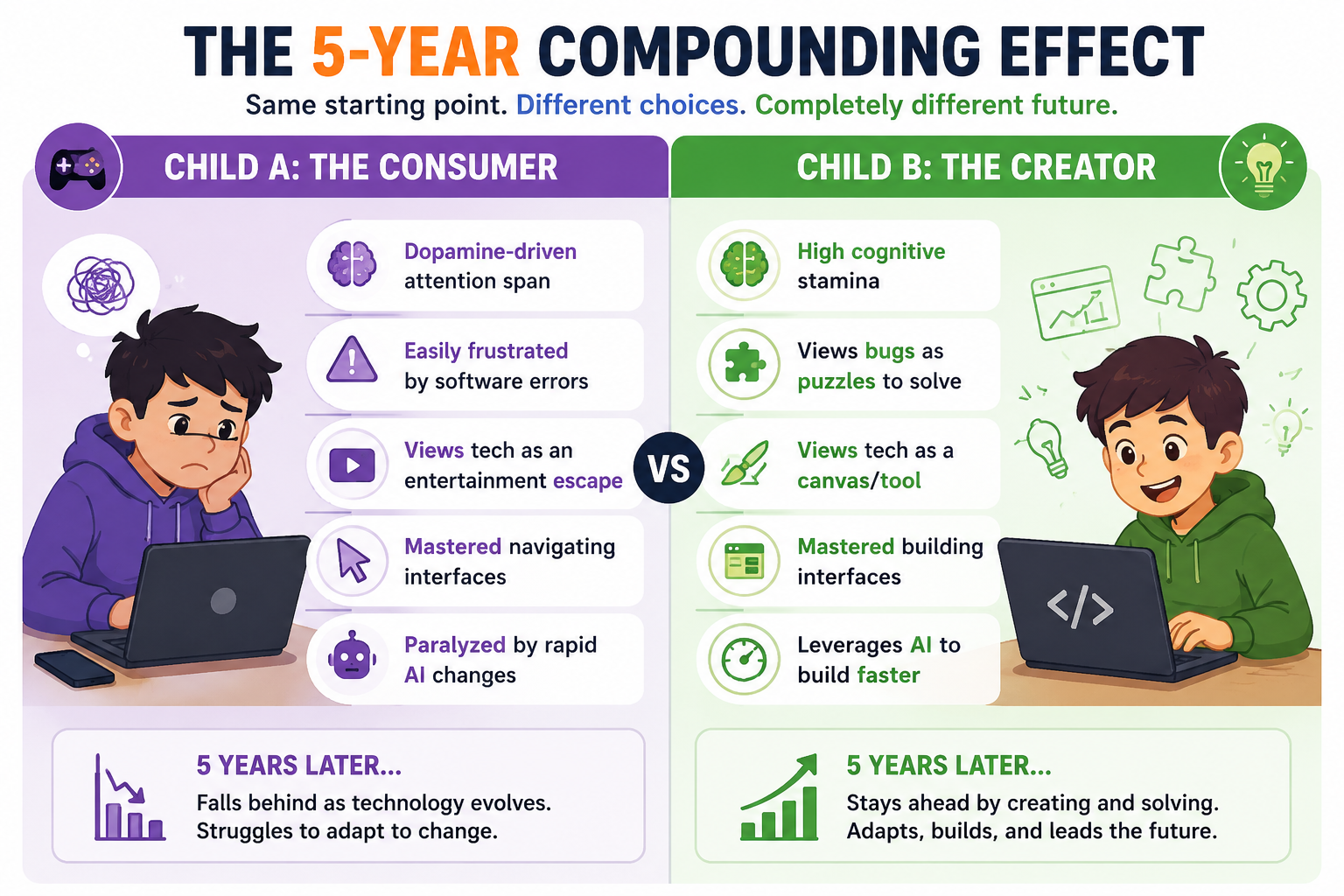
At age 15, Child A is highly digitally literate in the traditional sense. They know how to download apps, navigate social media algorithms, use shortcuts, and play complex games. However, they are entirely at the mercy of the software engineers who design these products.
When the apps change, they must adapt. When the algorithms shift, their attention is dragged along with it. They have spent five years training their brain to receive passive entertainment. They have become the product being monetized.
The Creator’s Edge
At age 15, Child B doesn't just use the digital world they help architect it. Because they spent those same five years creating, breaking, and fixing things, they have developed an entirely different cognitive architecture. They understand systems, logic, and variables.
When they see an application, they don’t just look at the design; they intuitively reverse-engineer how it handles data. They don't fear technological disruption or artificial intelligence; they look at new tools and ask, "How can I use this API to build something cooler?"
🛠️ The 3 Mental Shifts That Happen When Children Build
The massive divide that opens up over five years isn't just about technical skill. It is about psychology. Moving a child from a consumer mindset to a creator mindset completely rewired how they think.
1. From "This is Broken" to "Let's Debug It"
When a consumer encounters a software glitch or a broken tool, their default reaction is helplessness, frustration, or boredom. They close the app and move on.
When a creator encounters broken code, their brain treats it as an intellectual challenge. They isolate variables, read error messages, and systematically hunting down the problem. This builds intellectual resilience the literal habit of not giving up when things get difficult.
2. From Delayed Frustration to Rapid Feedback
Passive consumption offers instant gratification with zero cognitive effort. Creation, however, operates on a beautiful feedback loop:
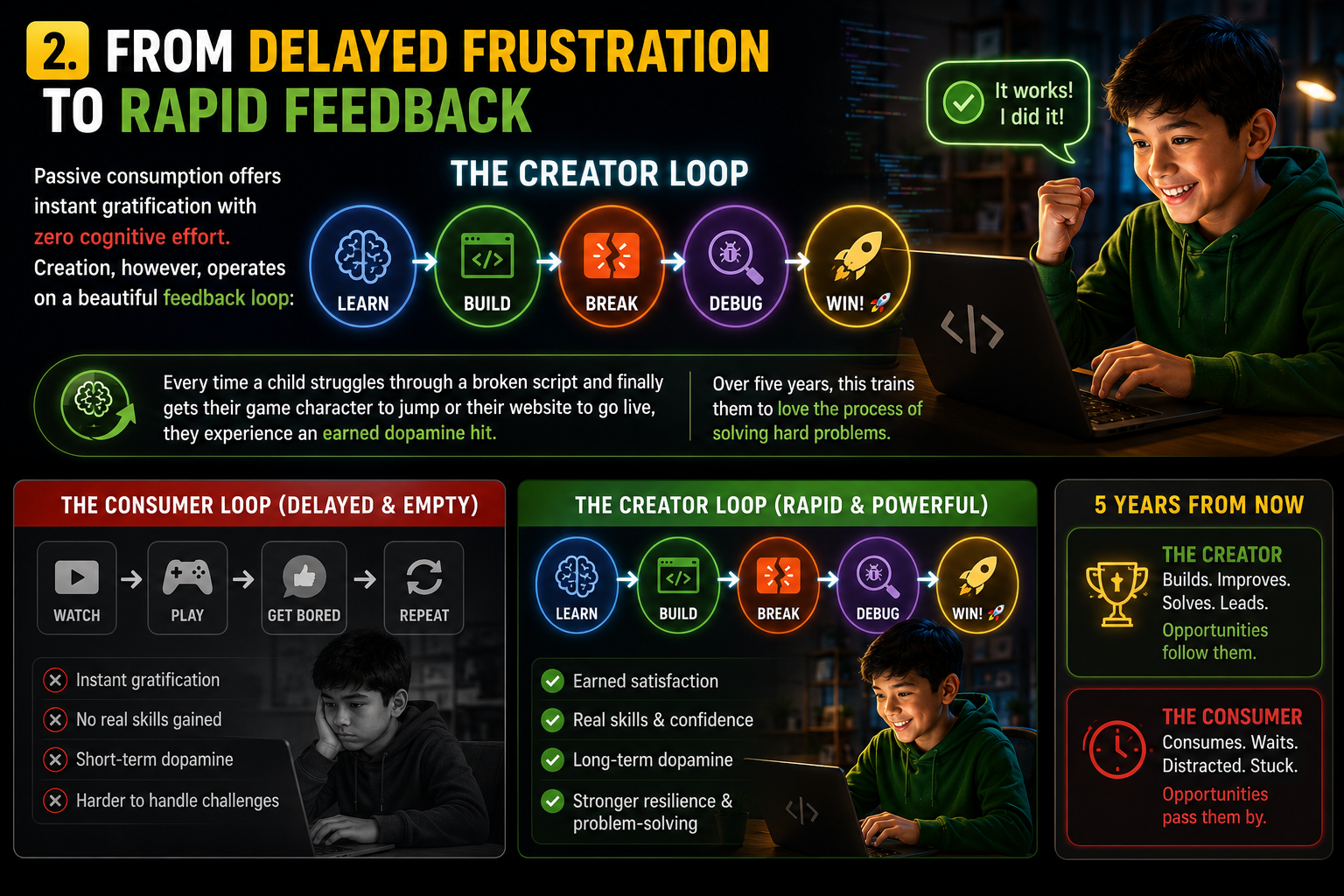
Every time a child struggles through a broken script and finally gets their game character to jump or their website to go live, they experience an earned dopamine hit. Over five years, this trains them to love the process of solving hard problems.
3. Mastering the Leverage of AI
In the modern landscape, consumers use tools like ChatGPT or specialized AI assistants to write their essays or generate quick entertainment, effectively outsourcing their thinking. Creators use AI as a co-pilot. They use it to write boilerplate code, debug complex syntax, and accelerate their production speed. One uses it to replace effort; the other uses it to multiply output.
🧭 How to Bridge the Gap: Turning Hobbies into Gateways
You don’t need to violently rip your child away from their favorite digital spaces to save them from the consumer trap. Instead, use their existing passions as a gateway into computer science.
Every passive consumer habit has a highly productive, creative counterpart:
If your child loves... | Don't just let them consume it... | Guide them to CREATE it: |
🎮 Playing Roblox or Minecraft | Staring at gameplay streams for hours | Learning Lua or Redstone logic to design custom worlds |
🎨 Editing photos or browsing layouts | Scrolling endlessly through feeds | Learning Web Development (HTML/CSS) to host a portfolio |
🧠 Chatting with AI Tools | Copy-pasting answers for homework | Learning Python to build and prompt custom AI agents |
🤖 Playing with tech gadgets | Buying the next expensive upgrade | Diving into Robotics to understand the hardware-software link |
🏫 Breaking the Consumer Cycle at True Coding School Phuket
The transition from consumer to creator rarely happens in a vacuum. If a child sits in their bedroom trying to learn entirely alone, a single frustrating error code can cause them to throw their hands up and retreat right back to the comfort of watching YouTube.
At True Coding School Phuket, we disrupt that cycle.
We don't believe in dry, boring lectures or forcing children to memorize rigid code syntax from a textbook. Our entire philosophy is built around Project-Based Learning. From day one, we treat our students as independent creators. Whether they are interested in Game Development, Python, Web Engineering, Robotics, or Artificial Intelligence, we give them the professional tools, the industry mentorship, and the collaborative environment they need to turn their screen time into a competitive advantage.
We don't just teach children how to write lines of code. We help them cross the 5-year divide, transforming them from passive consumers of technology into the confident, analytical creators of tomorrow.
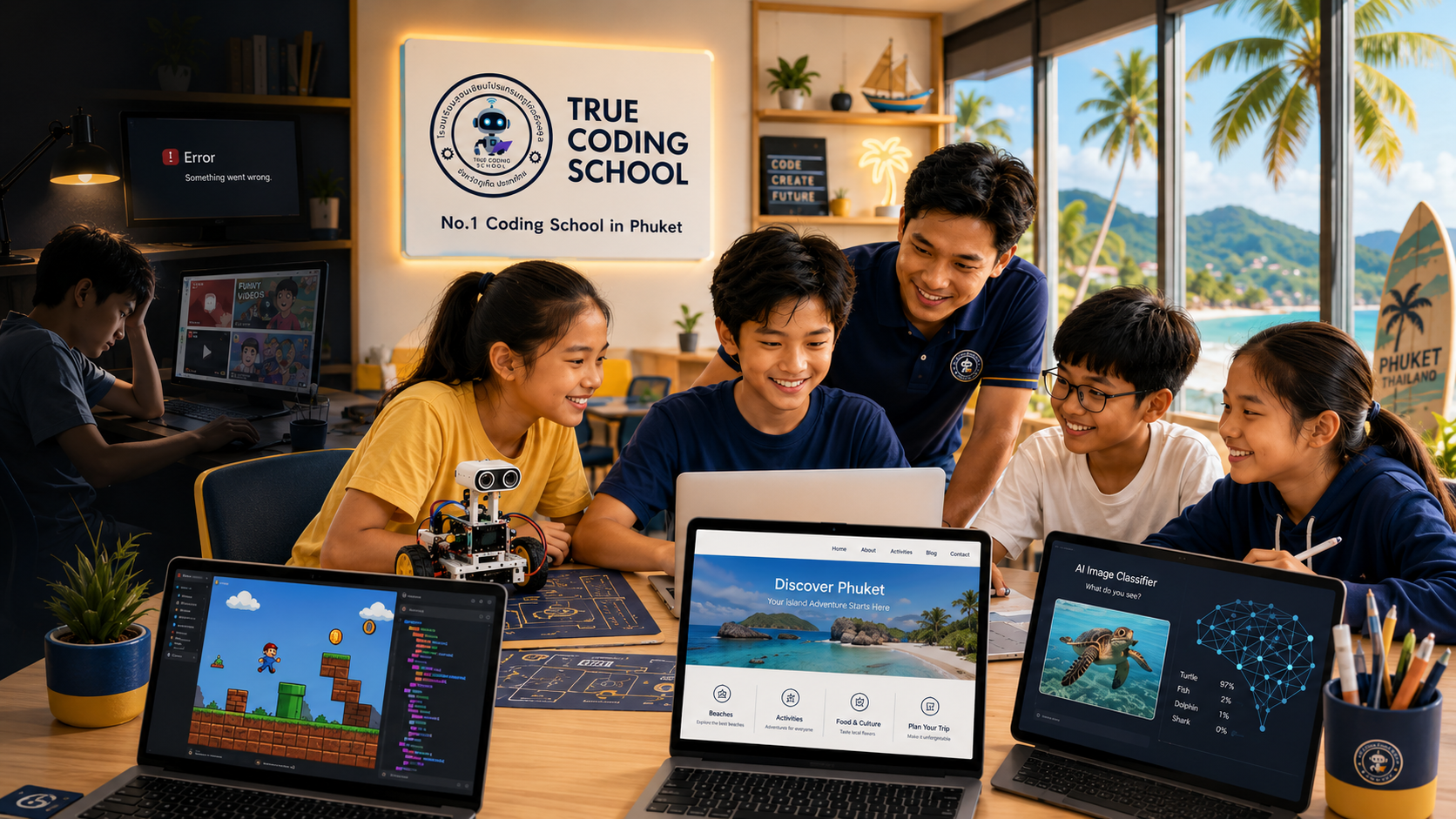
🚀 What could your child build if they started today?
Give your child the ecosystem, the guidance, and the community they need to build their own path to success. Get in touch with us at True Coding School Phuket today to explore our hands-on, project-based classes.
📋 Contact Information
Channel | Details |
📞 Phone | |
💬 Line |
|
📍 Address | 65/31 Moo 2, Chaofa-Suanluang Road, Vichit, Muang, Phuket 83000, Thailand |