
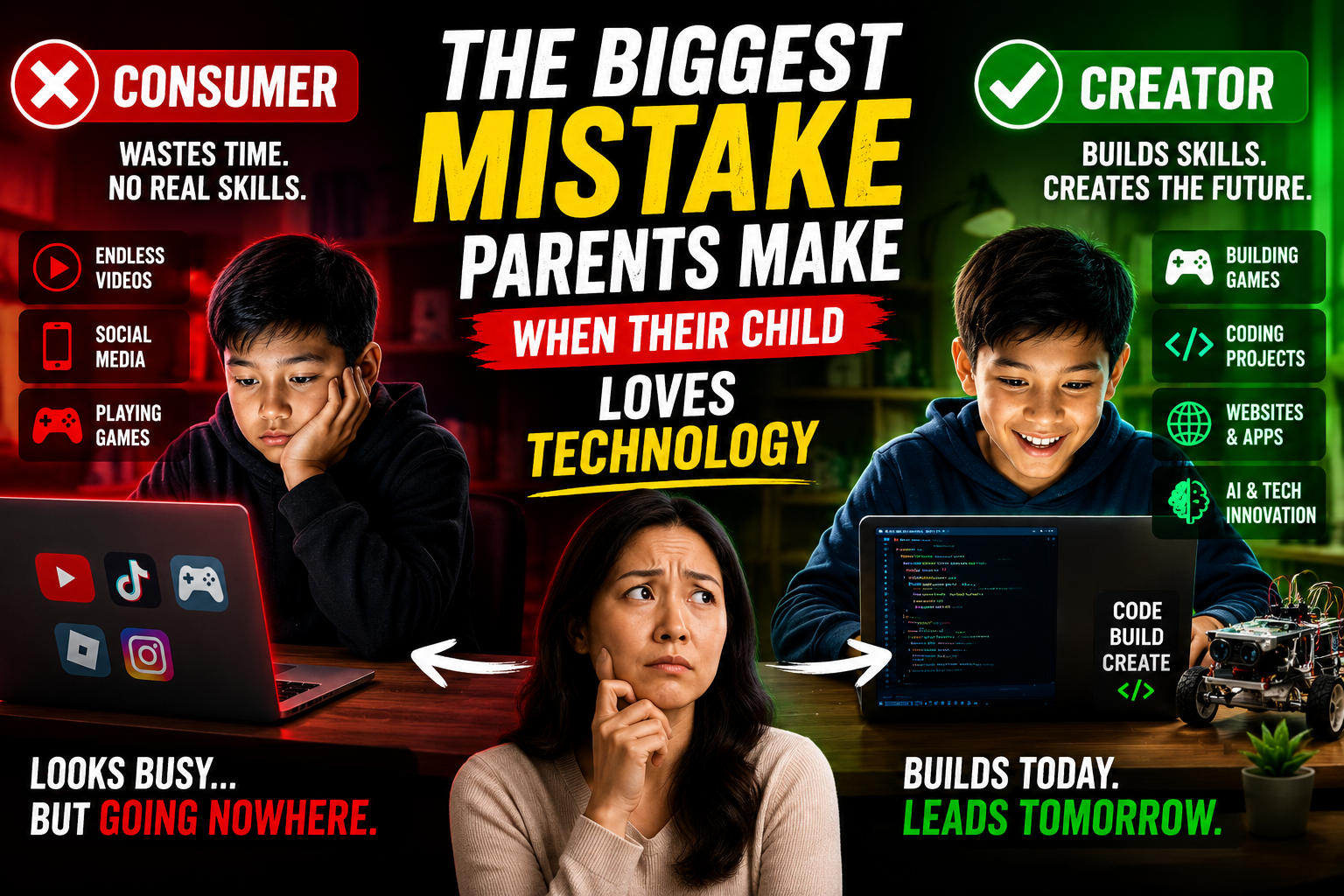
It is a scene played out in millions of households every single evening. A parent walks past their child's bedroom, glimpses the glow of a monitor, and feels a familiar knot of anxiety tighten in their chest.
Your child is glued to a screen again navigating Roblox, building in Minecraft, scrolling through YouTube, or messing around with new AI tools.
Your immediate, instinctive thought as a parent is almost always the same: "They are wasting their time."
And you are not entirely wrong. Technology can absolutely become a massive vacuum for a child's time and potential. But the choices you make in that exact moment of frustration can dictate your child's entire relationship with the digital world. In fact, many well-meaning parents make a critical error that accidentally kills their child's organic interest in technology altogether.
The mistake isn't letting them use devices. The mistake is trying to eliminate the technology entirely, instead of redirecting it.
👥 The Invisible Divide: Consumers vs. Creators
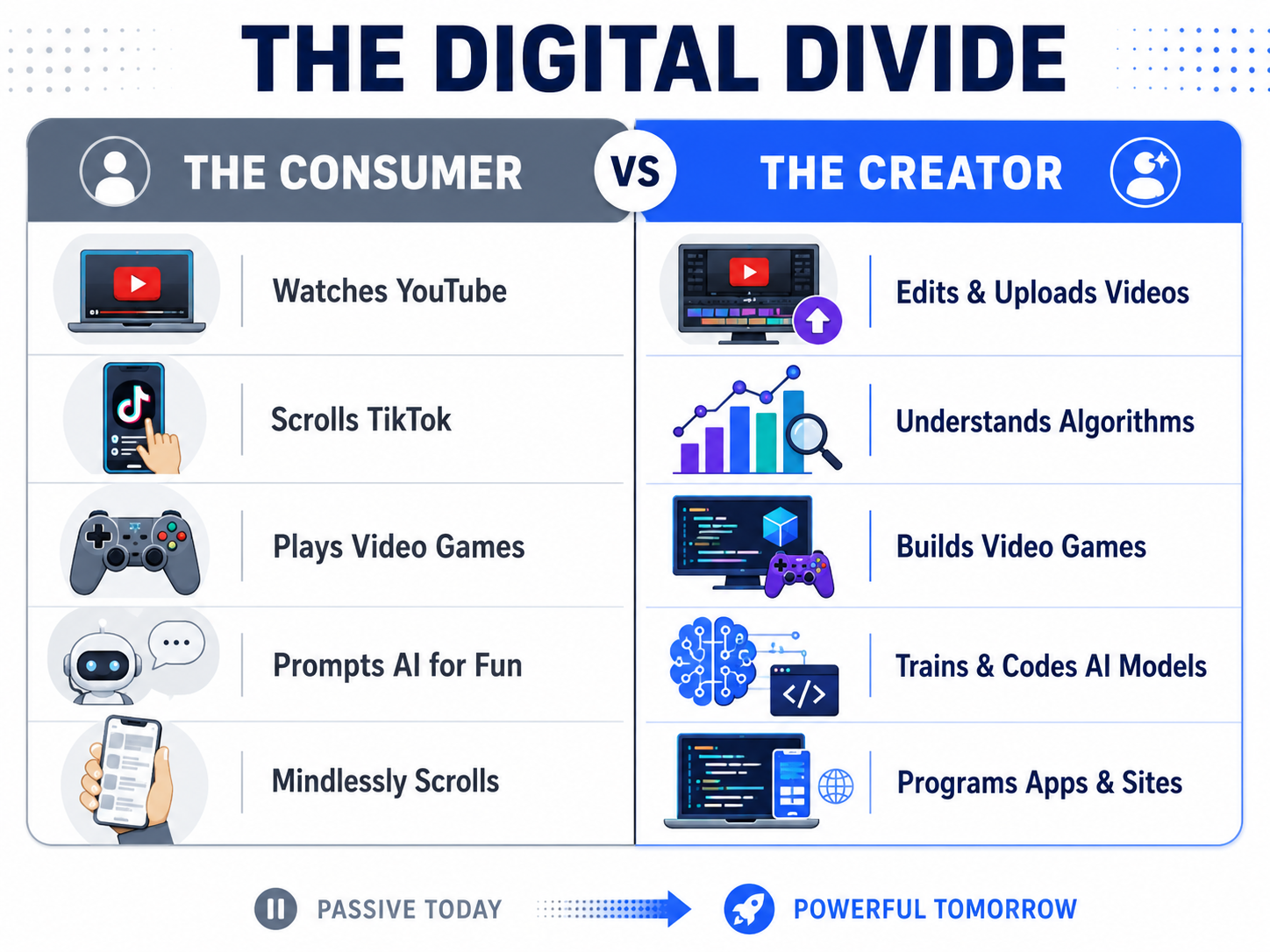
To understand why this mistake is so damaging, we have to look past the glass screen. Devices are entirely neutral; what matters is the direction of the data flow. In the modern world, tech users are strictly divided into two distinct categories:
The 5-Year Illusion
Imagine two children sitting side-by-side in identical chairs. Both spend exactly three hours on their respective computers.
Child A watches gaming streams, scrolls social media feeds, and plays matches of a popular video game.
Child B writes script modifications for a Roblox map, edits a basic HTML portfolio website, and experiments with a Python script to control an AI chatbot.
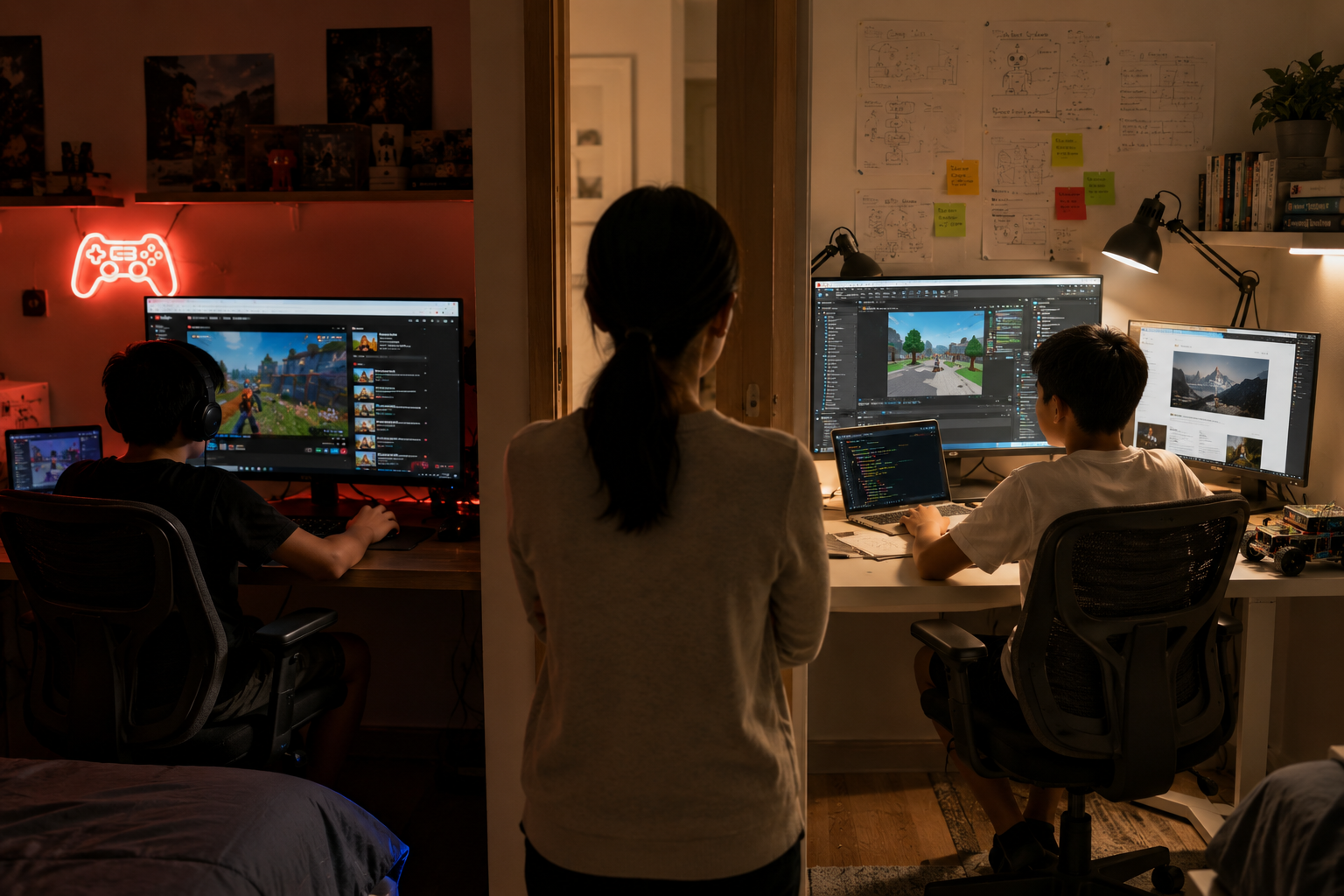
To a parent briefly walking past the doorway, these two children look exactly the same. Both are hunched over a keyboard, clicking a mouse, deeply immersed in a glowing display.
But fast-forward five years into the future. The divergence in their capabilities, career trajectories, and critical thinking skills will be absolutely enormous. One child has spent half a decade practicing passive entertainment. The other has spent half a decade training to become an architect of the digital age.
1. The Technology Trap: Why Banning Devices Fails
When parents see a decline in school grades or a lack of physical activity, the default reaction is often a total authoritarian ban: “No devices for a month.” While severe boundary-setting offers a temporary bandage, it rarely works as a long-term strategy. Technology is the fundamental infrastructure of the modern world. Banning a tech-obsessed child from their device doesn't make them less interested in it; it simply makes them resentful, teaches them to hide their usage, and isolates them from the tools that will define their future careers.
2. The Real Goal Isn't Less Screen Time—It's Better Screen Time
We need to shift the parenting narrative away from a purely quantitative metric (hours logged) to a qualitative metric (value produced).
If your child spends four hours a day passively consuming algorithmic brain-feed on short-form video apps, that is a problem that requires intervention. But if your child spends those same four hours deep in a flow state—debugging a complex loop, designing logic gates, or learning 3D modeling syntax—they aren't wasting time. They are studying.
The objective shouldn't be to pull them away from the screen; it should be to elevate what they are doing behind it.
3. How to Turn Passive Consumers into Active Creators
You don’t need to force your child to drop their current digital hobbies. Instead, leverage their existing passions as a bridge to computer science. Every passive habit has a highly productive, creative counterpart:
The Consumer Habit | The Creator Gateway | What They Actually Learn |
🎮 Playing Roblox | 🛠️ Game Development (Lua) | Object-oriented programming, physics, and logic |
🧱 Playing Minecraft | ⚡ Logic, Redstone & Architecture | Boolean logic, system design, and electrical concepts |
📺 Watching YouTube | 🎬 Content & Script Production | Storyboarding, video editing, and project management |
🤖 Chatting with AI Tools | 🧠 AI Development & Prompt Engineering | Natural language processing, variables, and data structures |
4. Why Some Children Become Builders
The shift from a consumer mindset to a creator mindset rarely happens by accident in an isolated bedroom. Children who successfully make this leap almost always have access to a specific ecosystem:
Real-World Projects: They aren't grading themselves on multiple-choice quizzes; they are building things that actually work, fail, and break in real-time.
Rapid Feedback Loops: When a child gets stuck on an error code for three hours alone, they quit. When a mentor can point out the missing bracket in three seconds, the child stays motivated.
An Inspiring Community: Human beings are social creatures. When a child is surrounded by peers who think coding, hardware hacking, and building software is cool, their internal motivation skyrockets.
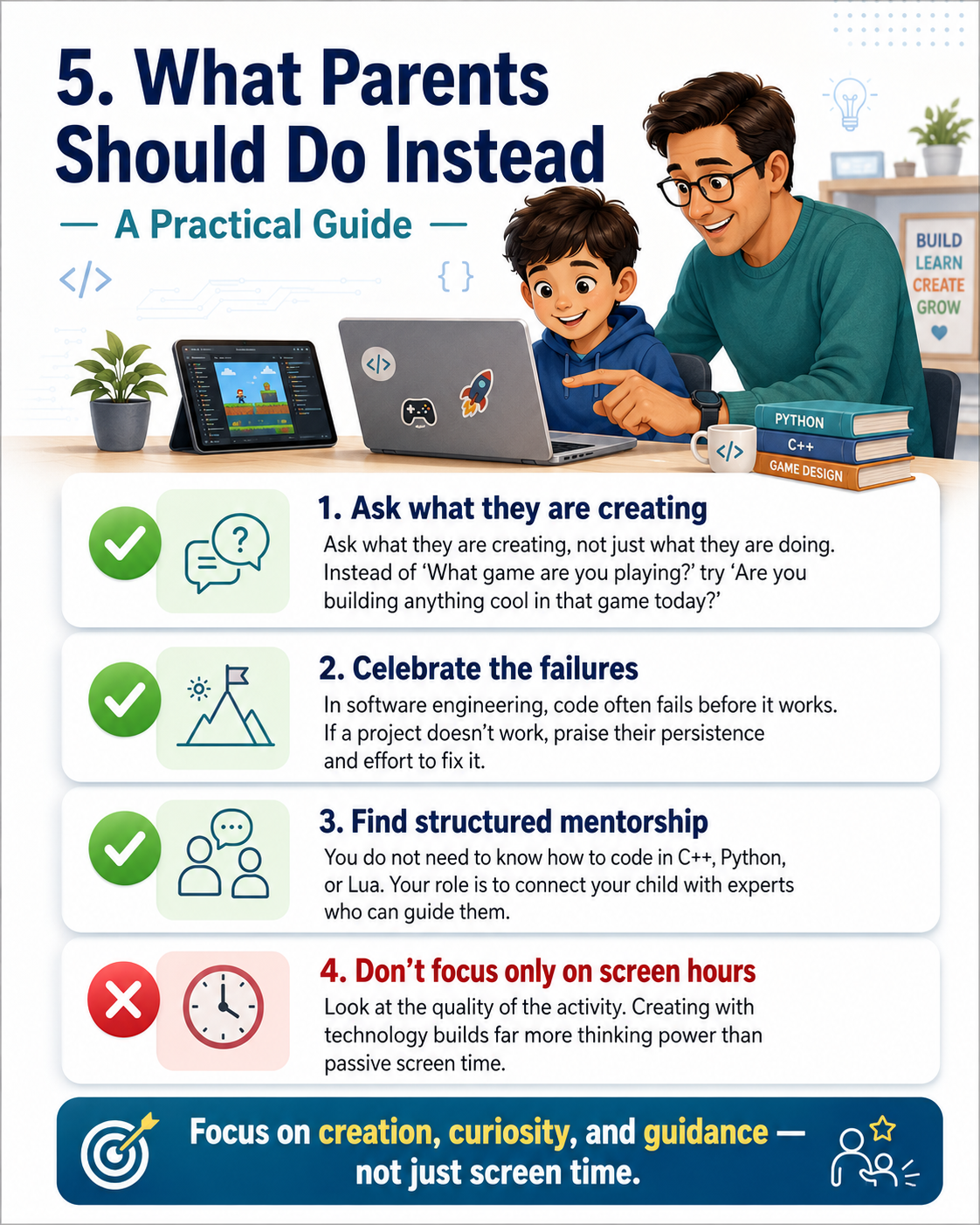
5. What Parents Should Do Instead: A Practical Guide
If you want to support your child's interest in technology without allowing them to fall down the rabbit hole of passive consumption, adjust your daily strategy:
✅ Ask what they are creating, not just what they are doing. Shift your vocabulary. Instead of asking "What game are you playing?" try asking "Are you building anything cool in that game today?"
✅ Celebrate the failures. In software engineering, code fails 99% of the time before it runs correctly. If a project doesn't work, praise their persistence for trying to fix it.
✅ Find structured mentorship. You do not need to know how to code in C++, Python, or Lua to guide your child. Your job is simply to provide them with experts who do.
❌ Don't just obsess over screen hours. Look closely at the nature of the activity. A child programming an autonomous drone for two hours is utilizing far more brainpower than a child staring blankly at television reruns for thirty minutes.
🏫 Turning Consumption into Creation at True Coding School Phuket
At True Coding School Phuket, we don't just teach the abstract, dry theory of computer programming.
Our core mission is to help children successfully move from consuming technology to creating it.
We take the natural fascination your child already has for games, computers, and digital media, and we channel it into marketable, real-world skills. Through hands-on, project-based classes, our students progress from complete programming beginners to independent developers who design their own software, build custom games, and engineer smart AI systems.
Don't let your child's passion for the future get trapped in a loop of endless scrolling. Let's transform their screen time into a springboard for genuine innovation.
🚀 Want to see what your child can build?
Get in touch with us today to learn more about our specialized, project-based classes and help your child build a meaningful path to tech mastery.
📋 Contact Information
Channel | Details |
📞 Phone | |
💬 Line |
|
📍 Address | 65/31 Moo 2, Chaofa-Suanluang Road, Vichit, Muang, Phuket 83000, Thailand |