The Children Growing Up With AI Will Think Differently
We May Be Watching the Birth of a New Kind of Childhood
The First Generation That Never Learns Alone
Every generation grows up with technologies their parents never had. For some, it was television. For others, it was the internet. Then came smartphones. Each innovation quietly changed the way people learned, communicated, and understood the world.
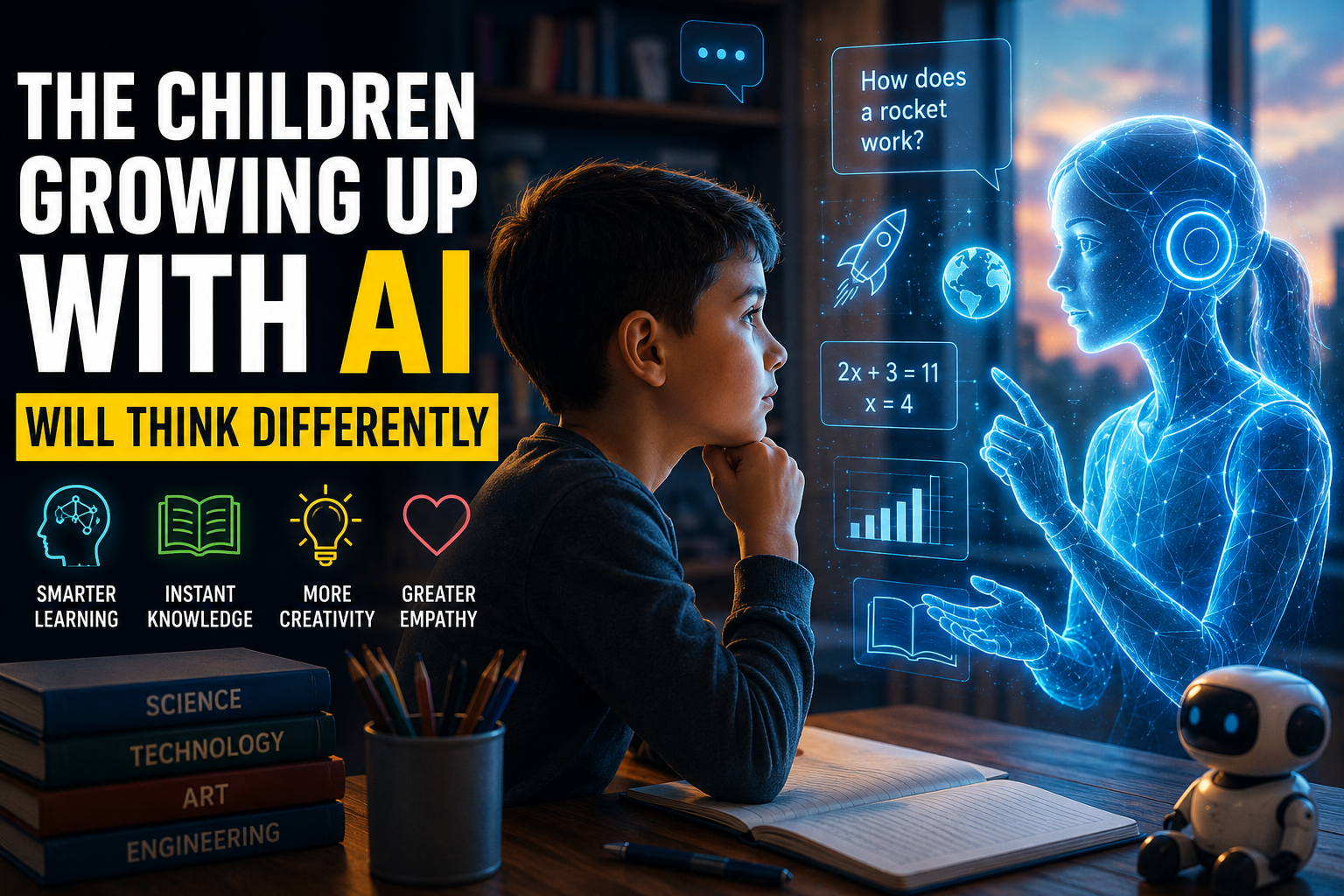
But artificial intelligence feels entirely different. This is not just another tool; it is something closer to a companion. For the first time in human history, children are growing up with technology that can answer questions, explain complex ideas, generate stories, solve problems, and hold genuine conversations.
The Shift
Kids are no longer simply using software. They are interacting with intelligence. And that shift may fundamentally rewire how an entire generation thinks.
The barrier between curiosity and answers is completely disappearing. When answers become instantly accessible, children may start asking more questions simply because the cost of curiosity has never been lower.
Curiosity Could Become a Superpower
For most of human history, information was a scarce resource. Books were expensive luxuries, experts were difficult to access, and knowledge lived strictly behind the walls of libraries, universities, and specialist institutions.
Today: Knowledge lives in a device that fits in a pocket.
Tomorrow: It will live in an AI companion that understands exactly how each individual child learns.
This creates an extraordinary possibility: the children who ask the most questions may gain the greatest advantage. They won't win because they know more, but because they learn faster. In an age of unlimited information, curiosity becomes infinitely more valuable than memorization.
Learning May Become Deeply Personal
The Traditional Classroom | The AI-Augmented Future |
One teacher responsible for dozens of students. | Infinite scale; one-on-one attention. |
Fixed pacing (the class moves together). | Hyper-personalized pacing (moves with the child). |
Standardized delivery (text/lecture). | Dynamic delivery (visuals, games, stories, logic). |
Artificial intelligence has the potential to break the rigid mold of industrialized education. Imagine a tutor available twenty-four hours a day—one that never gets frustrated, never gets tired, and never rushes a student. An AI tutor can explain the same concept a hundred different ways until it finally clicks.
But There Is a Catch...
Every powerful technology creates a double-edged sword. When obtaining answers becomes entirely effortless, independent thinking can become optional.
Why struggle with a complex problem if an AI can solve it instantly?
Why write an essay if an AI can draft one in seconds?
Why retain information if knowledge is always a voice command away?
These questions are deeply concerning to educators around the world. The challenge of the future may not be accessing intelligence, but knowing when to rely on it and when to trust your own mind. The children who thrive will be those who learn to use AI as a leverage tool rather than a replacement for cognitive heavy lifting.
The Skills That May Matter Most
Many assume that coding, prompt engineering, or advanced robotics will be the defining skills of the upcoming era. The reality may be much more surprising. The most valuable skills may remain deeply, inherently human:
The Human Core Skillset
Critical Thinking & Judgment — AI can provide answers, but humans must decide which answers are true and which questions are worth asking.
Creativity & Originality — Connecting dots in ways algorithms haven't yet mapped.
Empathy & Deep Communication — Understanding human emotion, culture, and context.
A Different Way of Seeing the World
Children growing up with AI will develop expectations previous generations never could have dreamed of. They will expect instant explanations, real-time feedback, and hyper-personalized interaction. What feels revolutionary to us will feel like water to a fish for them.
We are witnessing a monumental tech transition:
Future generations will read about this era in history books. Not because AI replaced schools, but because it fundamentally altered how human minds explore, discover, and think.
The Real Question
The question is no longer whether children will grow up alongside artificial intelligence. That ship has sailed; that future is already here.
The Ultimate Choice
Will our children become passive consumers of pre-packaged answers? Or will they become curious explorers capable of learning faster than any generation before them?
The technology itself will not make this decision. Parents, educators, and students will. The choices made today will design how the next generation understands the world tomorrow.