
Have You Ever Found a “Bug” in a Game?
Maybe you've seen a character get stuck in a wall, a button stop working, or a game suddenly crash.
Today, programmers use the word "bug" to describe an error or problem in software.
But did you know the term originally came from a real insect? 🐛
A Computer Mystery in 1947
Let's travel back to 1947.
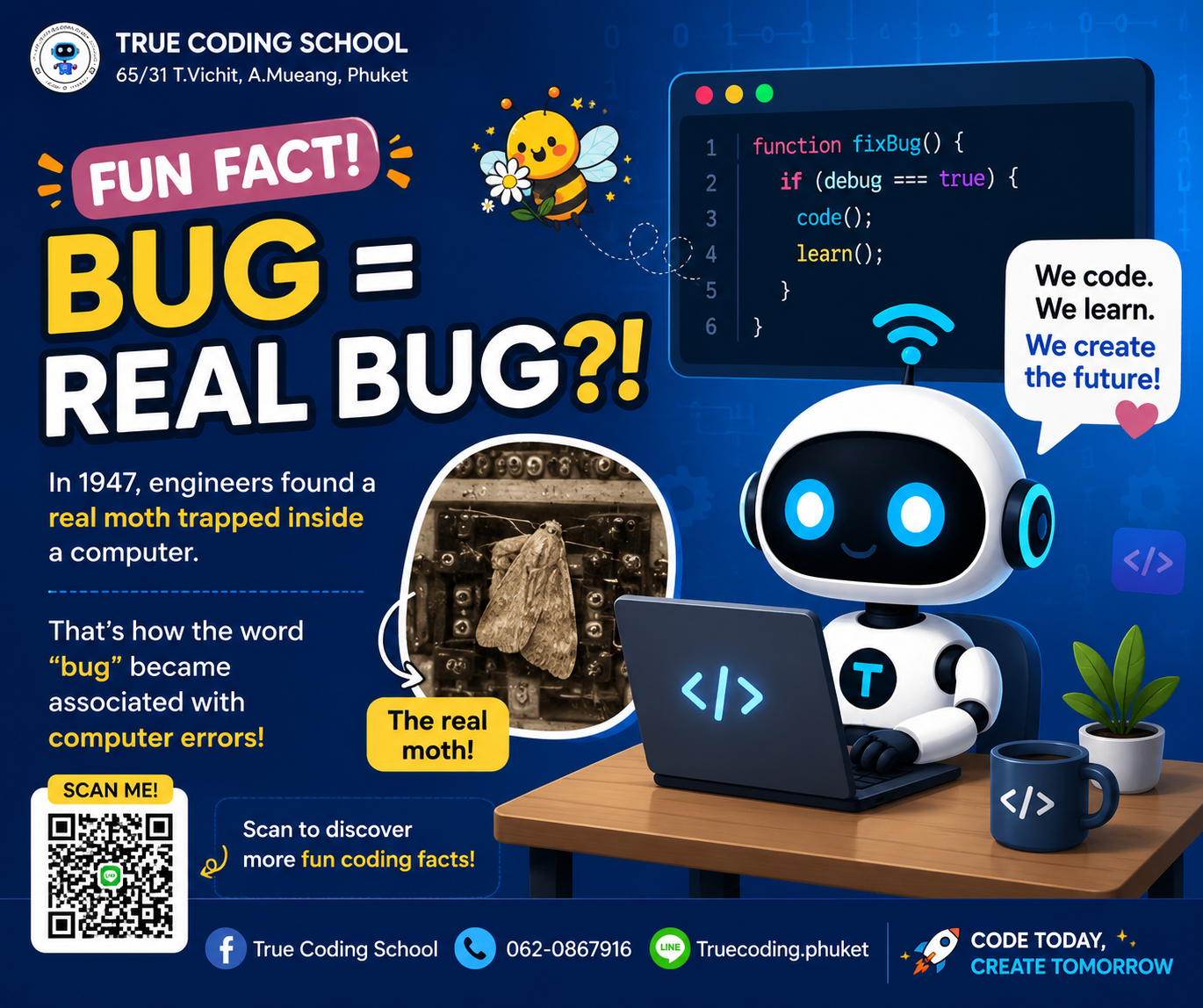
A team of engineers and computer scientists at Harvard University was working on the Mark II, one of the world's earliest computers.
One day, the machine began malfunctioning unexpectedly.
The team carefully inspected the computer to find the cause of the problem.
What they discovered surprised everyone.
A small moth had become trapped inside one of the computer's relays, interfering with the electrical circuit and causing the machine to fail.
🦋 The "bug" was literally a bug!
The Birth of a Famous Tech Term
Computer scientist Grace Hopper and her team removed the moth and recorded the incident in their logbook.
Next to the insect, they wrote:
"First actual case of bug being found."
Although engineers had used the word "bug" informally before, this famous incident helped popularize the term throughout the computing world.
Since then:
A Bug means an error in a program.
Debugging means finding and fixing those errors.
In a way, programmers today are still "removing bugs"—just not the flying kind! 🐞
Why Debugging Is an Important Skill
One of the biggest lessons students learn when coding is that mistakes are completely normal.
Even professional software engineers spend a significant amount of time debugging their code.
Every bug becomes an opportunity to learn, investigate, and improve.
The goal isn't to avoid mistakes—it's to learn how to solve them.
What Students Learn at True Coding School
At True Coding School Phuket, debugging is an important part of the learning process.
When students build games, websites, AI projects, or apps, they regularly encounter challenges that require them to think critically and solve problems independently.
Through debugging, students develop:
🧠 Logical thinking
🔍 Attention to detail
💡 Problem-solving skills
🚀 Persistence and resilience
These skills extend far beyond programming and help students become confident learners in any field.
Every Programmer Encounters Bugs
The next time your child encounters a bug in a game or while coding, remember:
The term began with a real insect trapped inside a computer nearly 80 years ago.
And just like the engineers who solved that problem in 1947, today's young programmers learn by investigating, experimenting, and finding solutions one bug at a time. 🐛💻✨