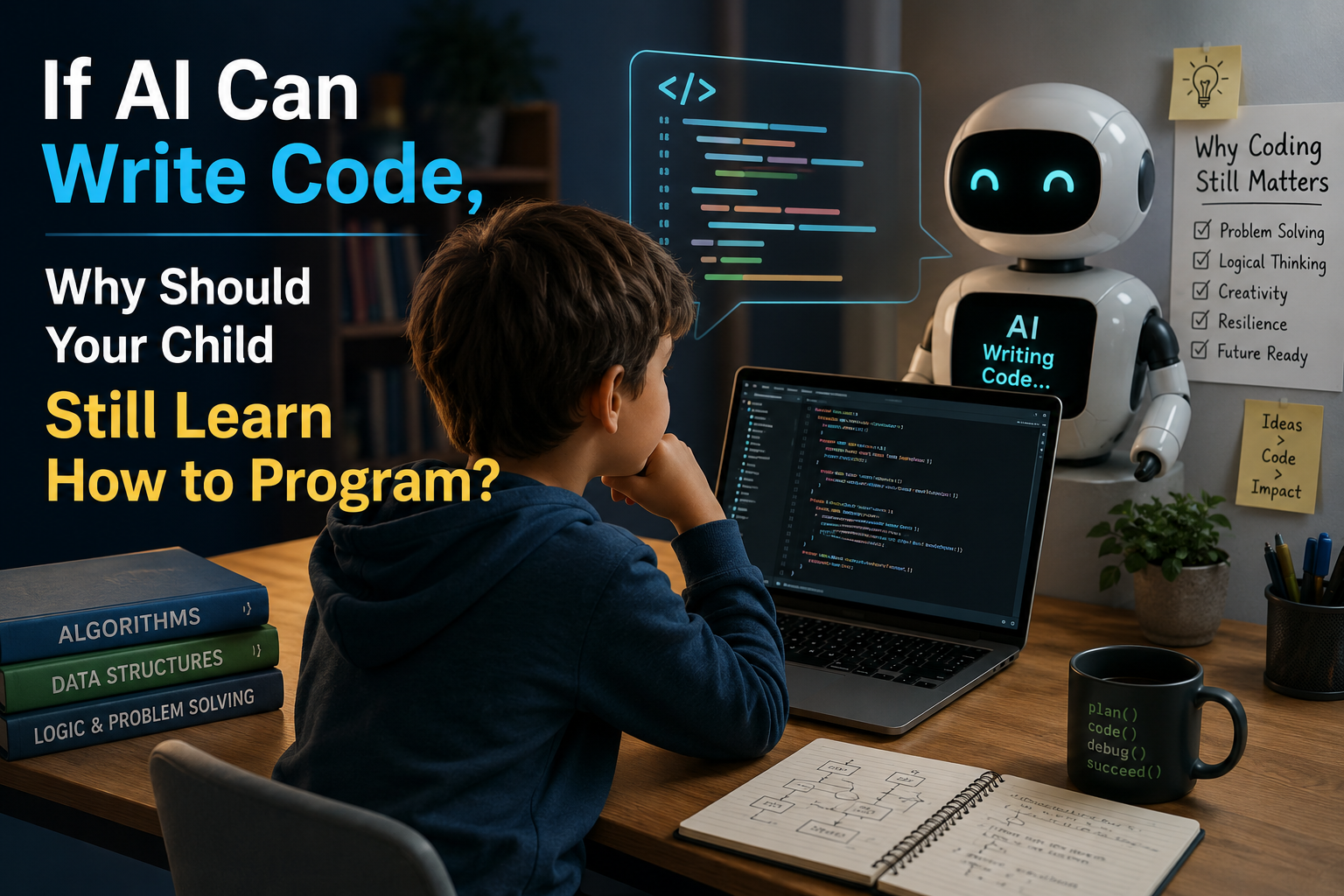
We are currently living through the most dizzying, jaw-dropping tech revolution in human history. With the explosive rise of ultra-sophisticated Artificial Intelligence platforms, the entire digital landscape has shifted beneath our feet. Today, anyone can sit in front of a screen, type a single, casual sentence into a prompt box, and watch a machine generate a fully functioning website, a mobile application, or a complex software script in a matter of seconds.
Naturally, this sudden shift has sent a massive shockwave of anxiety through parents and educators worldwide. A question that echoes through school hallways and dinner tables alike is: "If AI can already write code, is learning programming an absolute dead end for the next generation?"
It sounds logical on the surface. Why spend months or years mastering the intricate languages of machines if an algorithm can spit them out instantly for free?
However, the world's elite tech visionaries and leading educational institutions are sending a completely different signal. They aren't scaling back on computer science they are doubling down. Why? Because learning to code in the age of AI is no longer about memorizing lines of text. It has evolved into a high-stakes arena of structural design, creative leadership, and human mastery over the machine.
🤖 The Great Shift: From Syntax Memorizers to System Architects
To understand why programming remains an irreplaceable superpower, we have to look past the surface of the screen. AI is not eliminating the need for software creators; it is fundamentally altering what a creator actually does. The era of the isolated coder who simply translates instructions into lines of code is coming to an end. In its place, a far more powerful role has emerged.
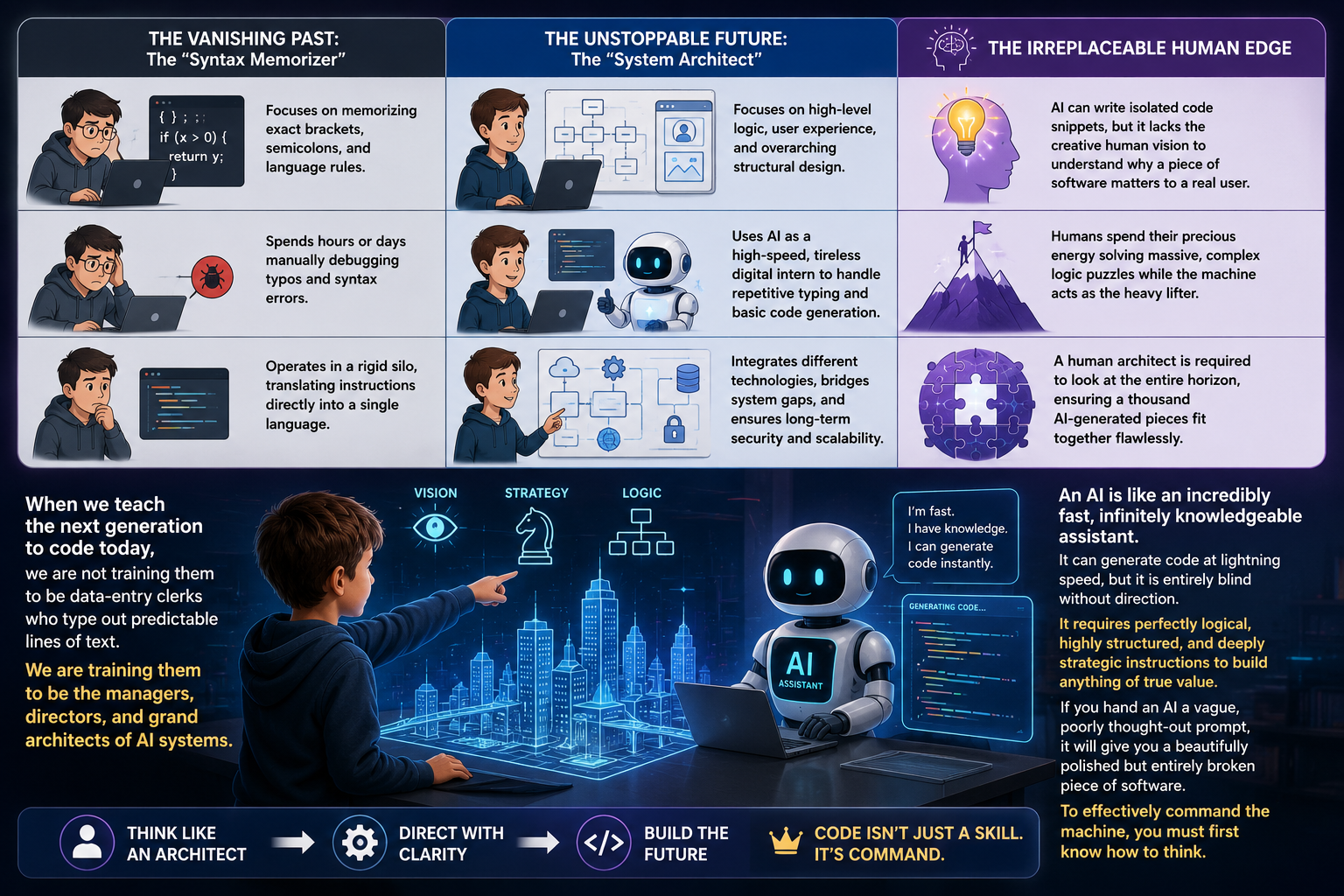
The table below breaks down this profound transformation, illustrating why human intelligence remains the ultimate director of technology
The Vanishing Past: The "Syntax Memorizer" | The Unstoppable Future: The "System Architect" | The Irreplaceable Human Edge |
Focuses on memorizing exact brackets, semicolons, and language rules. | Focuses on high-level logic, user experience, and overarching structural design. | AI can write isolated code snippets, but it lacks the creative human vision to understand why a piece of software matters to a real user. |
Spends hours or days manually debugging typos and syntax errors. | Uses AI as a high-speed, tireless digital intern to handle repetitive typing and basic code generation. | Humans spend their precious energy solving massive, complex logic puzzles while the machine acts as the heavy lifter. |
Operates in a rigid silo, translating instructions directly into a single language. | Integrates different technologies, bridges system gaps, and ensures long-term security and scalability. | A human architect is required to look at the entire horizon, ensuring a thousand AI-generated pieces fit together flawlessly. |
When we teach the next generation to code today, we are not training them to be data-entry clerks who type out predictable lines of text. We are training them to be the managers, directors, and grand architects of AI systems.
An AI is like an incredibly fast, infinitely knowledgeable assistant. It can generate code at lightning speed, but it is entirely blind without direction. It requires perfectly logical, highly structured, and deeply strategic instructions to build anything of true value. If you hand an AI a vague, poorly thought-out prompt, it will give you a beautifully polished but entirely broken piece of software. To effectively command the machine, you must first know how to think.
🧠 The Psychological Armor: Gymnastics for the Brain
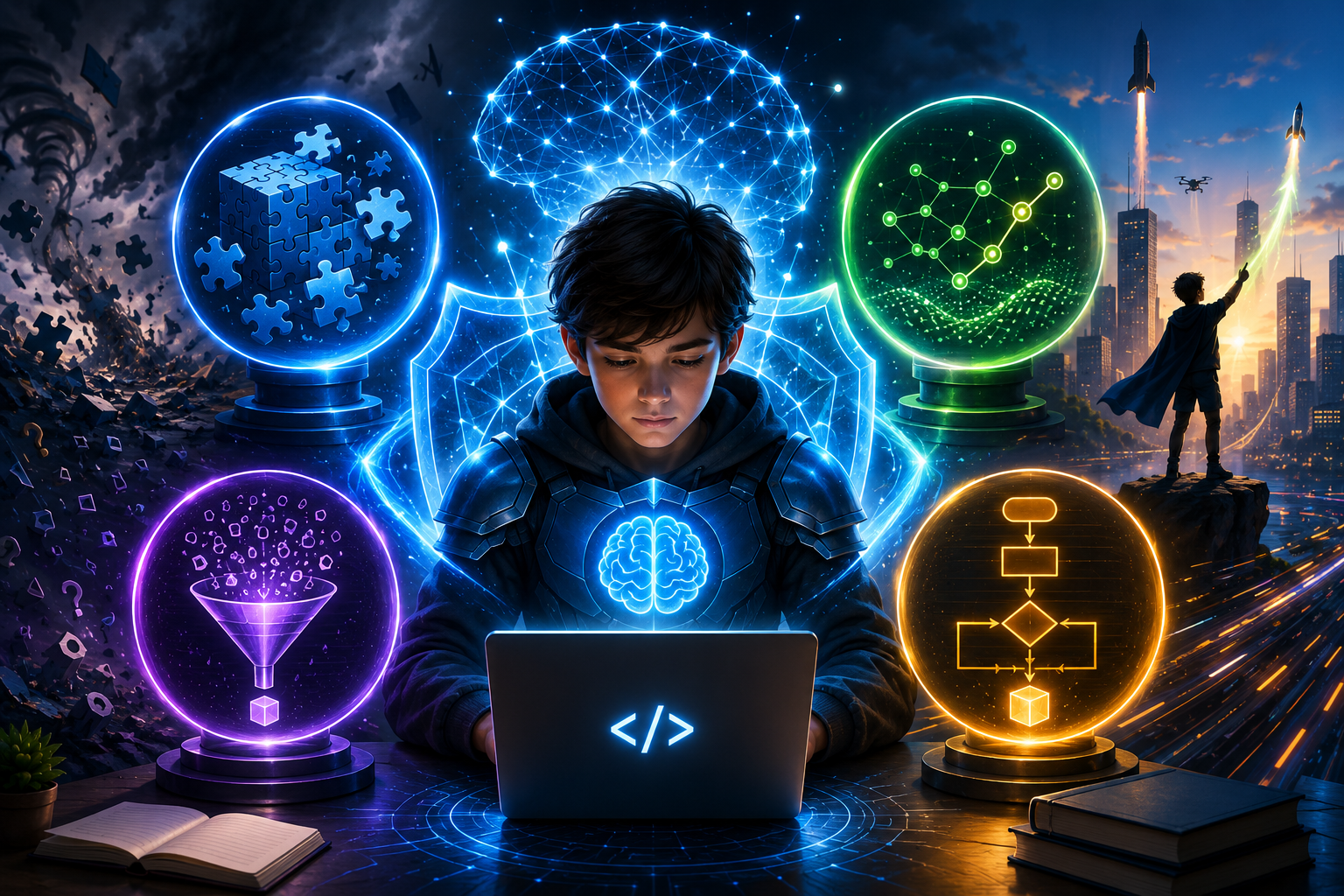
"Coding is the closest thing we have to real-world magic. You type commands into a silent machine, and a brand-new digital reality appears out of absolutely nothing. AI changes the brush, but it doesn't change the artist."
When a young mind learns how to program, they aren't just learning how to build software they are undergoing intensive mental conditioning. They are mastering a cognitive framework called Computational Thinking, a way of processing reality that serves as an armor against future automation.
This cognitive framework is built on four pillars that cannot be automated:
Decomposition: The ability to look at a massive, terrifyingly complex problem whether it is a system failure, a startup launch, or a global crisis and break it down into tiny, manageable, and conquerable pieces.
Pattern Recognition: Train the brain to look at a sea of chaotic data, find hidden similarities, and predict what will happen next based on structural trends.
Abstraction: The elite skill of cutting through endless digital noise, ignoring irrelevant details, and laser-focusing only on the core information that moves the needle.
Algorithmic Design: Crafting a flawless, step-by-step roadmap that allows anyone or any machine to achieve a desired outcome perfectly, every single time.
AI can generate answers, but humans must still possess the genius to ask the right questions. The mental agility developed through learning to code trains children to be sharp, resilient, and deeply analytical. If a child only knows how to consume AI content, they become entirely dependent on the machine. But if they know how to code, they become the ones who dictate where the technology goes next.
🌌 True Coding School: Unleashing the Creators of Tomorrow
At True Coding School, we don't teach students to compete with AI. We teach them to master it.
We recognized early on that traditional computer science education based on boring rote memorization, copying stale code from text-heavy boards, and passing multiple-choice exams is completely obsolete in the modern era. That is why our entire philosophy is built on immersive, high-energy Project-Based Learning.
In our vibrant classrooms, we guide kids, teens, and young adults to transition from passive consumers of technology into active digital creators. Instead of fearing the future, our students learn how to harness their logical thinking to architect games, design real-world applications, and conquer complex problems from scratch. We give them the tools to command technology, rather than letting technology command them.
Whether your child dreams of stepping into the global tech industry, launching a disruptive digital startup, or simply acquiring the razor-sharp analytical mind required to dominate any 21st-century career, the journey begins here.
Do not let your child just live in an AI-driven world. Teach them how to build it.
📞 Claim Your Launchpad at True Coding School
Ready to transform your child's screen time into a lifetime of innovation, fearless logical discovery, and creative confidence? Reach out to our education team at True Coding School Phuket today to discover our hands-on programs:
📞 Phone: +66 62 086 7916
💬 Line ID:
Truecoding.phuket✉️ Email: info.truecodingschool@gmail.com
📍 Address: 65/31 Moo 2, Chaofa-Suanluang Road, Vichit, Muang, Phuket 83000, Thailand