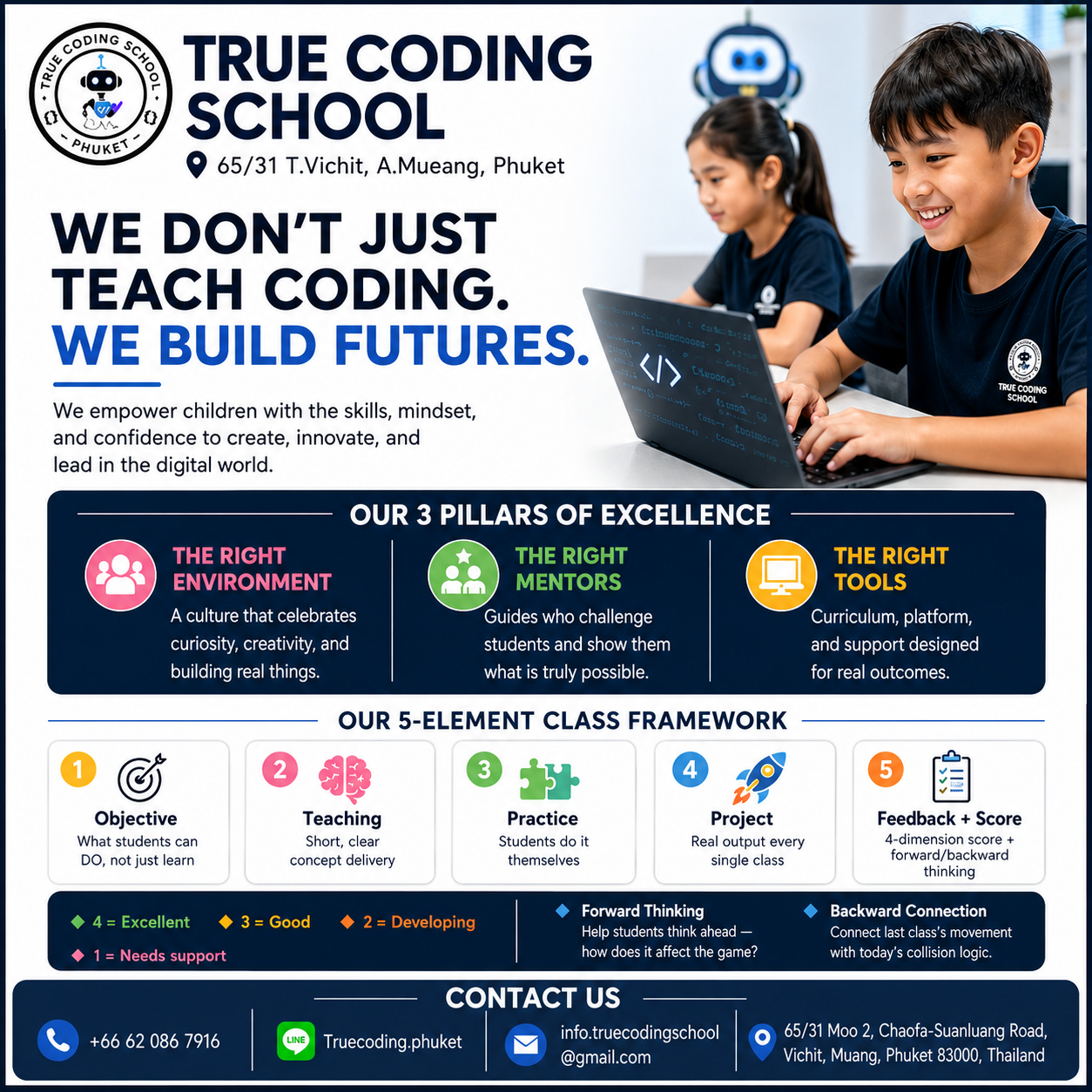
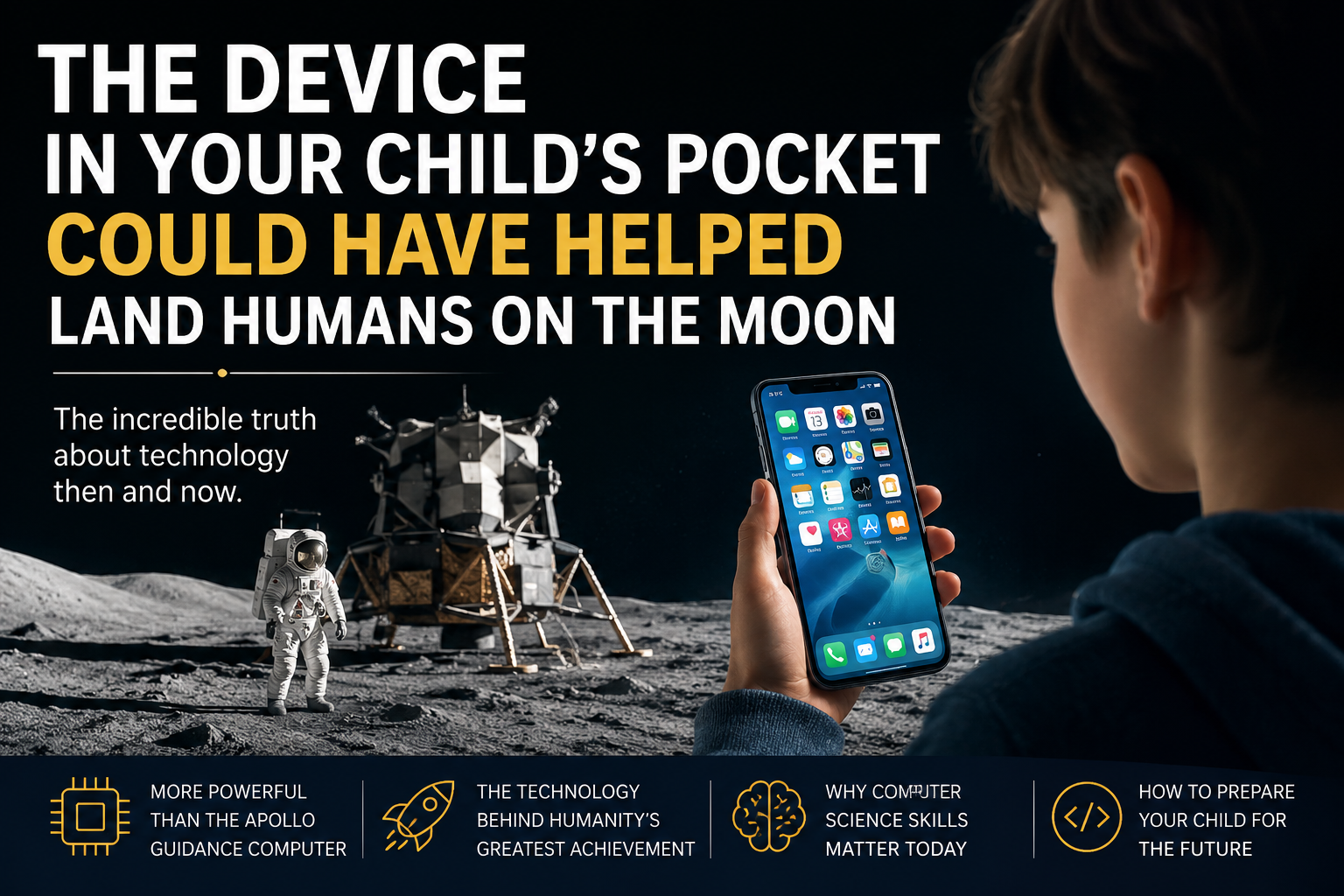
The Device in Your Child's Pocket Could Have Helped Land Humans on the Moon
On a warm July night in 1969, an estimated 530 million people sat transfixed before their television sets, watching a grainy, black-and-white broadcast transmitted across a quarter of a million miles of empty space. They witnessed the impossible: two human beings walking on the surface of the Moon. It was an era-defining achievement born of human bravery, intense geopolitical competition, and what was universally hailed as the absolute pinnacle of twentieth-century technological innovation.
To safely navigate three brave astronauts across the cosmic void, NASA's finest minds had to design a computing system completely from scratch. The result was the Apollo Guidance Computer (AGC) a boxy, seventy-pound metallic brain that represented the absolute bleeding edge of global technology. It was considered an absolute miracle of engineering.
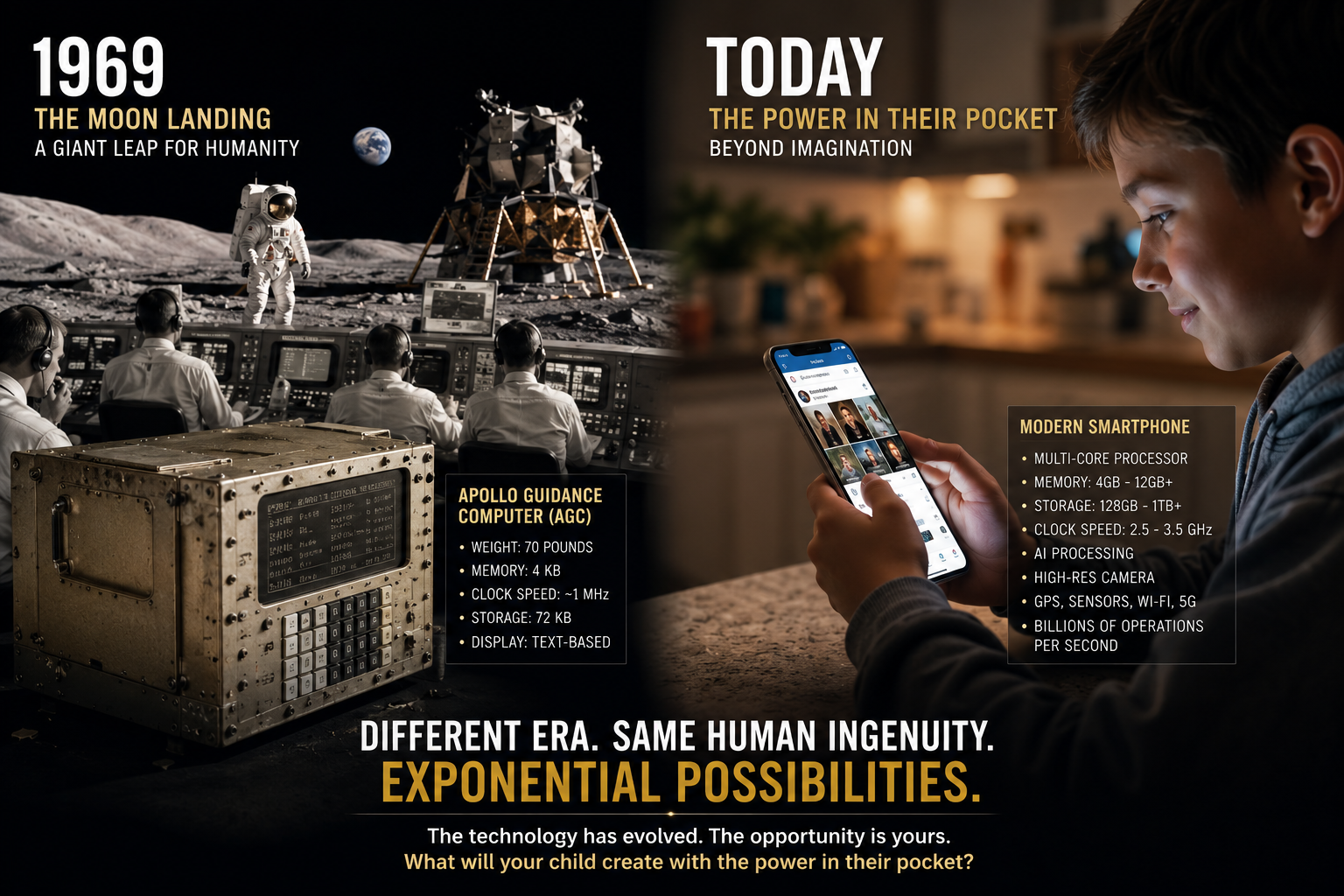
Now, take a moment to look at the slim, lightweight smartphone sitting in your child’s pocket, resting on the kitchen counter, or lighting up their face as they scroll through social media feeds. That ordinary, everyday device possesses more raw, unadulterated computing power than the entire global infrastructure NASA utilized to send humanity into the unknown and bring them safely back to Earth.
If you have ever wondered about the true potential of the digital generation, the reality of the technology they carry with them every single day is nothing short of mind-boggling.
📊 The Cosmic Disparity: Side-by-Side Comparison
When we look back at the archival footage of Apollo 11, it is incredibly easy to imagine that NASA’s control rooms were packed to the brim with digital technology comparable to what we use today. In reality, the entire historic journey was executed on what modern engineers would consider digital training wheels.
To help visualize this massive technological leap, the table below highlights the vast differences between the historic Apollo Guidance Computer and the standard device your child uses to browse the internet, stream videos, and play games today:
Technological Aspect | Apollo Guidance Computer (1969) | Modern Smartphone (Today) | The Real-World Impact |
Physical Weight | Around 70 pounds (32 kilograms) | Around 6 ounces (180 grams) | Heavy metal dashboard vs. lightweight pocket device |
Operational Memory (RAM) | A tiny fraction of a single megabyte | Massive gigabyte capacities | The smartphone handles millions of times more active data simultaneously |
Data Storage System | Hand-woven magnetic copper ropes | Solid-state digital microchips | Millions of times more space to store documents, photos, and media |
Primary Tasks Performed | Basic orbital calculations and navigation commands | Running 3D physics engines, streaming HD videos, and tracking GPS | Multi-tasking a complex digital symphony every single second |
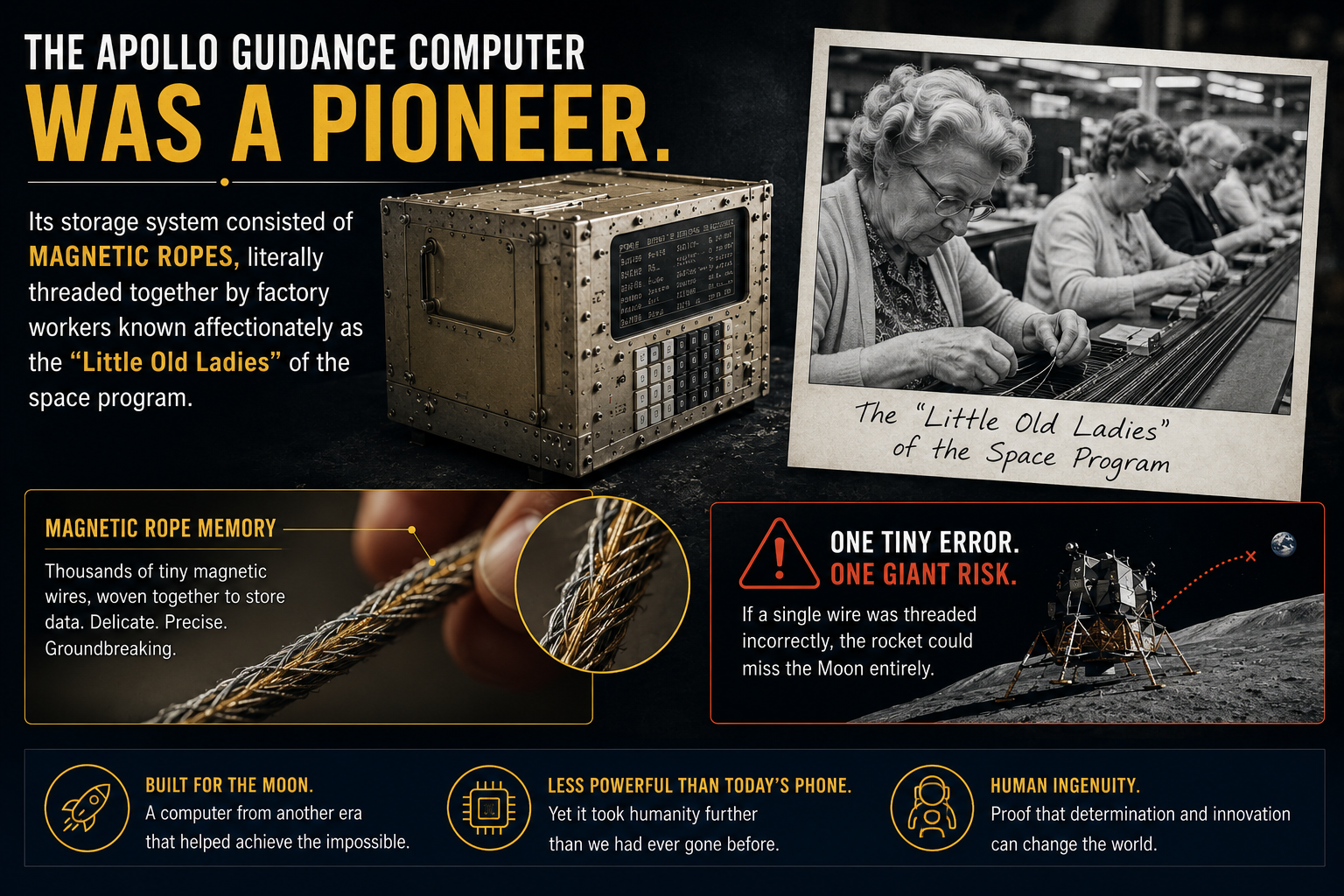
The Apollo Guidance Computer was a pioneer. Its storage system consisted of magnetic ropes, literally threaded together by factory workers known affectionately as the "Little Old Ladies" of the space program. If a single wire was threaded incorrectly, the rocket could miss the Moon entirely.
Today, when your child opens up a modern mobile game with rich, three-dimensional graphics, their phone isn't just processing a simple set of commands. It is managing high-definition displays, tracking satellite location data, pinging cellular towers, running complex physics, and refreshing background applications all at once. In 1969, that level of instantaneous computational power would have been viewed not as science, but as pure magic. NASA would have happily traded an entire fleet of their finest research mainframes for just a few minutes of access to a single mid-range smartphone.
🧠 The Great Paradox: Supercomputers Used as Televisions
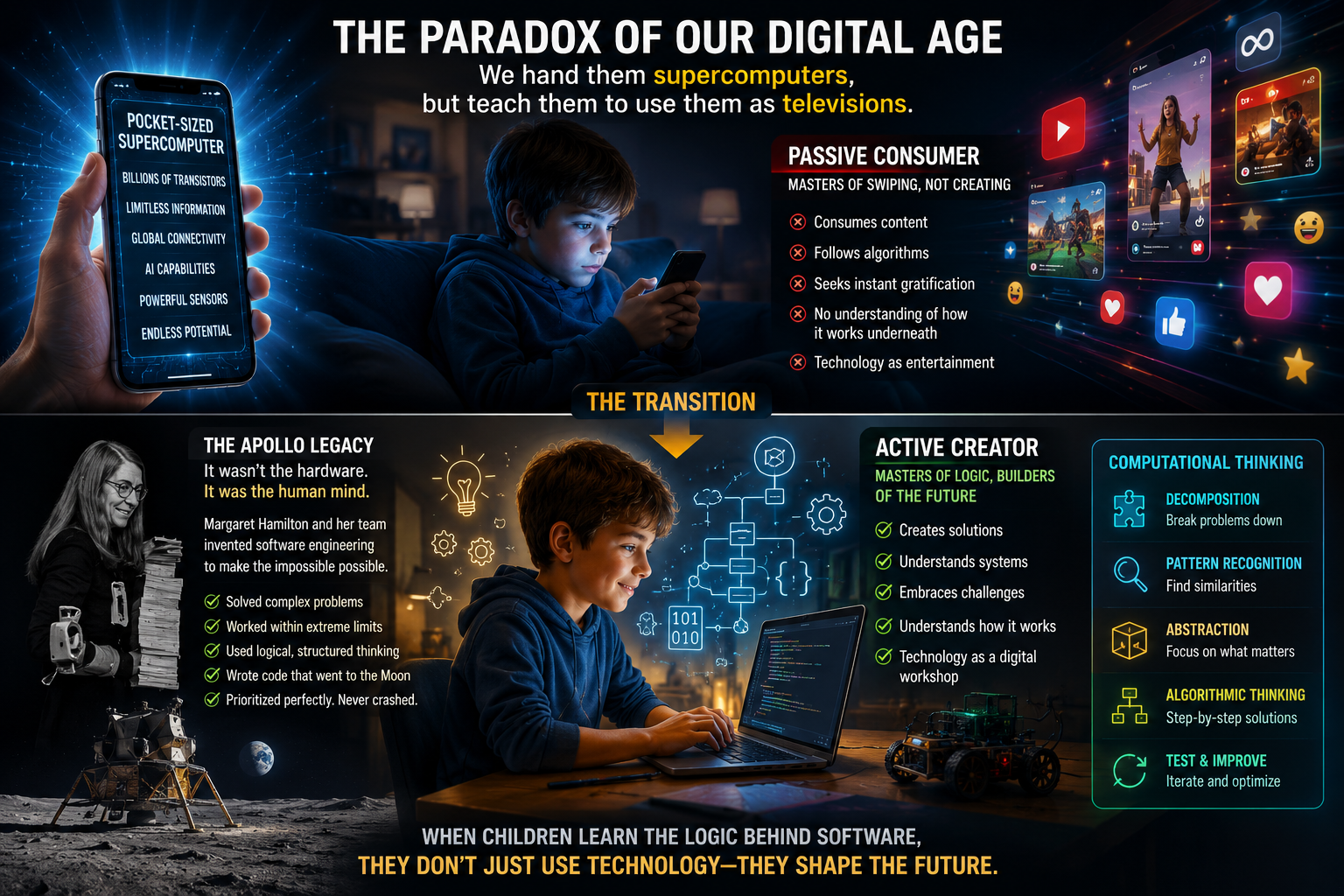
This staggering leap in technological capability brings us to a fascinating, yet critical paradox facing parents in the digital age.
"We are currently handing our children the keys to pocket-sized supercomputers, yet the modern digital landscape is primarily teaching them to use these incredible machines as mere televisions."
The true wonder of the Apollo program wasn't actually the physical hardware itself; it was the genius of the human minds who programmed it. Legendary computer scientists like Margaret Hamilton, who led the team that wrote the on-board flight software for Apollo, had to invent the very concept of software engineering as they went along. They faced severe memory limits and endless technical roadblocks, but they used structured, logical thinking to squeeze every single drop of potential out of their limited machines. They knew exactly how to prioritize tasks so that the computer wouldn't crash during lunar descent.
Today, our children experience the exact opposite reality. They have access to virtually limitless computing power, but the vast majority of them grow up exclusively as passive consumers of technology. They are absolute masters of swiping, tapping, and consuming content fed to them by algorithms designed by others to capture and hold their attention. They understand how the technology behaves on the surface, but they have no idea how it works underneath.
The real magic happens when a young mind makes the profound transition from a consumer into a creator. When a child learns the underlying logic of how software works, they stop looking at their phone as an entertainment toy and begin seeing it as a digital workshop. They begin practicing Computational Thinking the exact framework of systematic problem-solving, pattern recognition, data abstraction, and step-by-step algorithmic logic that engineers use to navigate the stars.
🌌 True Coding School: Launching Your Child’s Potential
At True Coding School, we believe that the incredible device your child carries around shouldn't just be an entertainment console it should be a launchpad for their imagination.
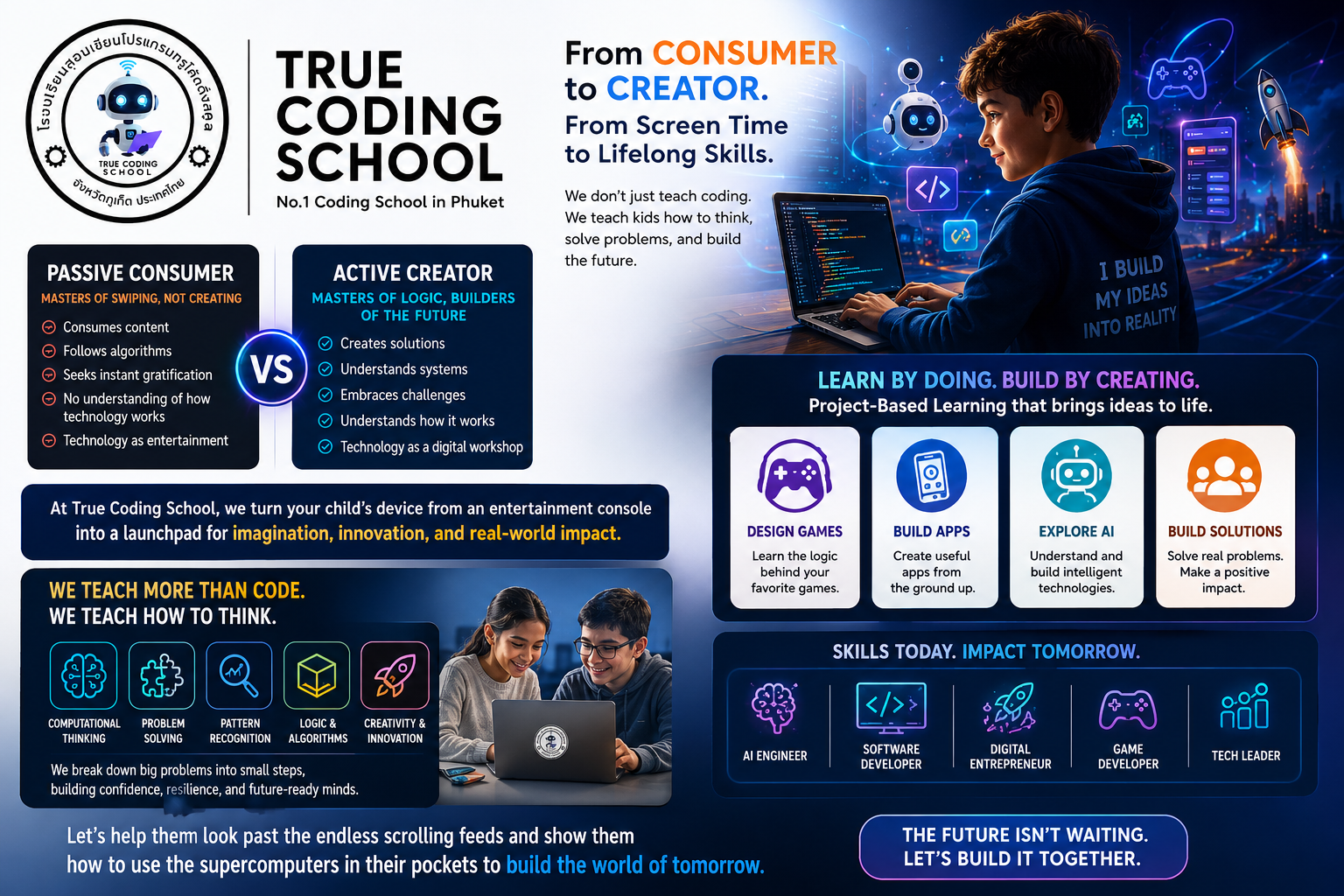
We don't expect every single student to build a rocket ship or work for an aerospace agency, but we do teach them how to think with the clarity, depth, and structure of the world's finest engineers. Through our interactive, Project-Based Learning philosophy, we guide students to pull back the curtain on their favorite technologies. Instead of just playing mobile games, they learn how to design the mechanics behind them. Instead of just using mobile applications, they learn how to architect and build them from scratch.
By teaching kids and teens how to break down massive, intimidating problems into small, manageable steps, we turn passive screen time into an active, lifelong asset. Whether your child eventually aspires to dive into artificial intelligence, engineer creative software, build digital communities, or lead a modern business, it all begins with mastering the logic and mindset behind the screen.
Let’s help them look past the endless scrolling feeds and show them how to use the supercomputers in their pockets to actively build the world of tomorrow.
📞 Connect with True Coding School
Ready to transform your child’s relationship with technology into a journey of logical discovery, academic excellence, and creative mastery? Reach out to our education team at True Coding School Phuket today to learn more about our specialized coding, logic, and problem-solving programs tailored for young creators:
📞 Phone: +66 62 086 7916
💬 Line ID:
Truecoding.phuket✉️ Email: info.truecodingschool@gmail.com
📍 Address: 65/31 Moo 2, Chaofa-Suanluang Road, Vichit, Muang, Phuket 83000, Thailand