
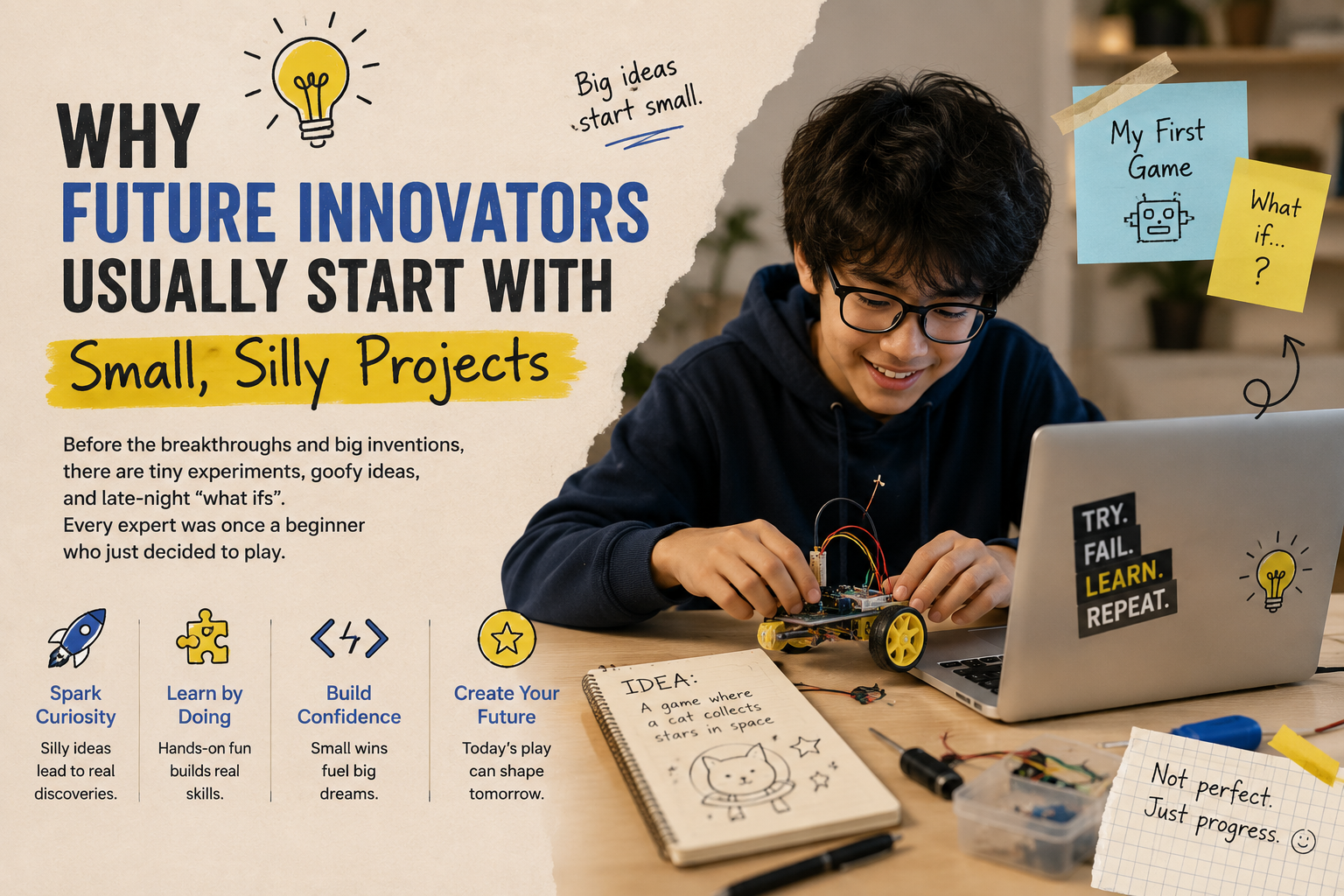
When people imagine the beginning of a successful technology career, they often picture a young genius building the next Google, creating groundbreaking AI, or launching a revolutionary startup.
The reality is usually much less impressive.
Many future innovators start with projects that seem small, strange, or even a little silly.
A game where a banana jumps over obstacles.
A website dedicated to cats.
A calculator that makes funny sounds.
A chatbot that only tells jokes.
And that's exactly how it should be.
Every Great Creator Starts Somewhere
Behind every successful app, game, or technology company is a person who once knew absolutely nothing about programming.
Before building complex software, they built simple projects.
Before solving big problems, they experimented with small ones.
The goal was never perfection.
The goal was learning.
Small Projects Create Big Lessons
Children learn best when they're excited about what they're building.
That's why the most valuable beginner projects are often the ones that seem completely unnecessary.
A student might spend hours creating a game where a chicken flies through space.
Another might build a website ranking their favorite snacks.
At first glance, these projects don't appear educational.
But underneath, students are learning:
💡 How to solve problems
💡 How to break ideas into smaller steps
💡 How to test and improve their work
💡 How to keep going when things don't work the first time
These skills are far more important than the project itself.
Creativity Comes Before Expertise
Many adults make the mistake of thinking children should only build "serious" projects.
But innovation rarely starts that way.
Children are naturally creative because they haven't yet learned all the reasons something supposedly can't be done.
They experiment.
They explore.
They try unusual ideas.
And sometimes those ideas lead to unexpected discoveries.
The freedom to create something fun often becomes the foundation for deeper learning later.
Failure Is Part of the Process
One thing every programmer, engineer, and entrepreneur has in common is this:
Their first projects were not very good.
Games crash.
Websites break.
Code refuses to work.
Buttons do nothing.
And that's okay.
Every mistake teaches something new.
In fact, some of the most important learning happens when students encounter problems and figure out how to solve them on their own.
The Confidence to Create
Perhaps the greatest benefit of building small projects is confidence.
The first time a child creates something from scratch, they realize that technology isn't magic.
It's something people build.
More importantly, it's something they can build.
That realization can change how they view learning, technology, and even themselves.
Today's Silly Project, Tomorrow's Big Idea
The world doesn't need children to create perfect projects.
It needs children who are willing to experiment, explore, and create.
A simple game today might inspire a future software developer.
A small AI project might spark an interest in machine learning.
A personal website might be the beginning of an entrepreneurial journey.
Every big innovation starts somewhere.
And very often, it starts with a small, silly project that nobody expected to matter.