
Humanoid Robots Went From Science Fiction to Factory Workers
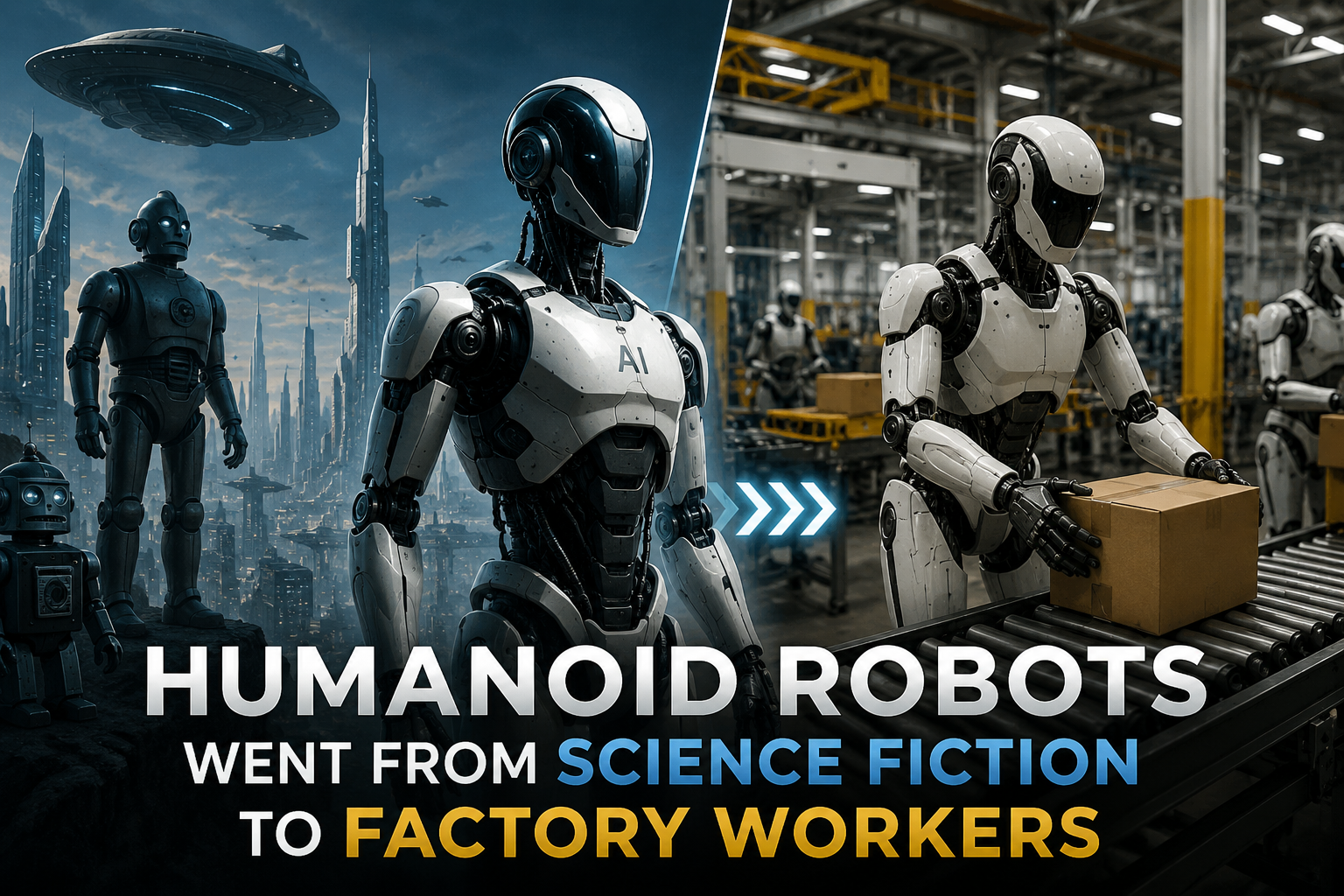
Humanoid Robots Went From Science Fiction to Factory Workers
The Moment Sci-Fi Became Reality
Not long ago, humanoid robots belonged entirely to the world of imagination. They lived in movies, walked through futuristic cinematic cities, and helped astronauts explore distant planets in stories that seemed impossibly far away. Most of us assumed we would never see that future—at least not in our lifetime.
Yet, somewhere inside factories, warehouses, and research labs around the world, something extraordinary has been happening: the future quietly arrived, and almost nobody noticed.
A New Kind of Worker Is Born
Picture a typical factory floor. Machines hum in the background, boxes move across conveyor belts, and workers carry tools from one station to another. Now, imagine a new employee entering that same environment.
It doesn't need lunch breaks.
It never gets tired.
It doesn't complain about repetitive work.
And it isn't human.
For decades, engineers dreamed of building a machine that could move through the world the way we do—to walk, reach, carry, balance, and adapt. Today, that dream is finally taking shape. Humanoid robots are no longer laboratory experiments; they are becoming real-world workers.
Why Make Robots Look Like Us?
It sounds like a strange idea at first. If robots are just machines, why not give them wheels? Why not design something faster, stronger, and mechanically more efficient?
The answer reveals something fascinating about our world: Everything around us was built for humans. Our doors, stairs, tools, vehicles, factories, and homes—humanity spent thousands of years designing a world perfectly suited for the human body. Instead of rebuilding the entire world to accommodate robots, engineers are teaching robots to operate within the world we already created. In a way, technology is no longer adapting us to it; technology is adapting itself to us.
The Race Has Already Begun
Across the globe, some of the most ambitious companies on Earth are competing to build the first truly useful humanoid robot. They aren't building toys, demonstrations, or science experiments. They are building real workers—machines capable of contributing value every single day.
Billions of dollars are being poured into a future that once seemed impossible. A future where robots work alongside people, and where labor itself may be transformed. The question is no longer if it will happen; the question is who will get there first.
The Missing Piece Was Never Hardware
Many people assume the recent explosion in robotics happened because robots suddenly became stronger, faster, or mechanically superior. But that isn't the biggest breakthrough. The real breakthrough was intelligence.
For years, robots struggled to understand the world. They could follow rigid instructions and repeat tasks, but they could not truly adapt or reason. Then, artificial intelligence changed everything. Modern AI systems can recognize objects, interpret environments, understand language, and learn from enormous amounts of data. For the first time in history, machines are beginning to understand the world rather than simply reacting to it.
What Happens When Robots Become Useful?
This is where the conversation becomes truly interesting. Humanoid robots are not being designed for distant futures; they are being designed for today's immediate problems:
Labor shortages
Aging populations
Dangerous working environments
Repetitive and physically demanding tasks
The first wave of humanoid robots will likely appear in places most people never see: factories, warehouses, distribution centers, and industrial facilities. These are places where efficiency matters most and repetitive tasks happen thousands of times every day. Once they prove themselves there, their role will expand—gradually, quietly, and relentlessly.
What They Still Can't Do
Despite all the excitement, reality remains stubbornly difficult. Humans are extraordinary biological machines. A toddler can perform tasks that still challenge some of the world's most advanced robots, such as:
Opening unfamiliar objects
Navigating highly cluttered rooms
Handling unexpected situations
Making split-second, intuitive decisions
These things seem effortless to us because millions of years of evolution have trained our brains to do them. For robots, these challenges remain enormous. The road ahead is long, but for the first time, it feels achievable.
The Future Arrives One Small Step at a Time
People often imagine the future as a single, dramatic headline—a world-changing announcement. In reality, change is usually much quieter.
The future arrives gradually: one improvement, one invention, and one breakthrough at a time. Humanoid robots will not suddenly appear everywhere overnight. Instead, one factory will adopt them. Then another. Then another. Years later, we'll look back and wonder how we ever thought they were impossible—the exact same way we now view smartphones, GPS navigation, and artificial intelligence.
A Question Worth Thinking About
Imagine a robot that costs less than a family car. It helps with household chores, carries groceries, moves heavy objects, assists elderly family members, and works safely alongside your loved ones.
Would you welcome it into your home?
Ten years ago, that question sounded absurd. Today, it feels surprisingly realistic. And perhaps that is the clearest sign of all: humanoid robots are no longer science fiction. They are becoming part of our present, and for the first time, that future feels close enough to touch.