
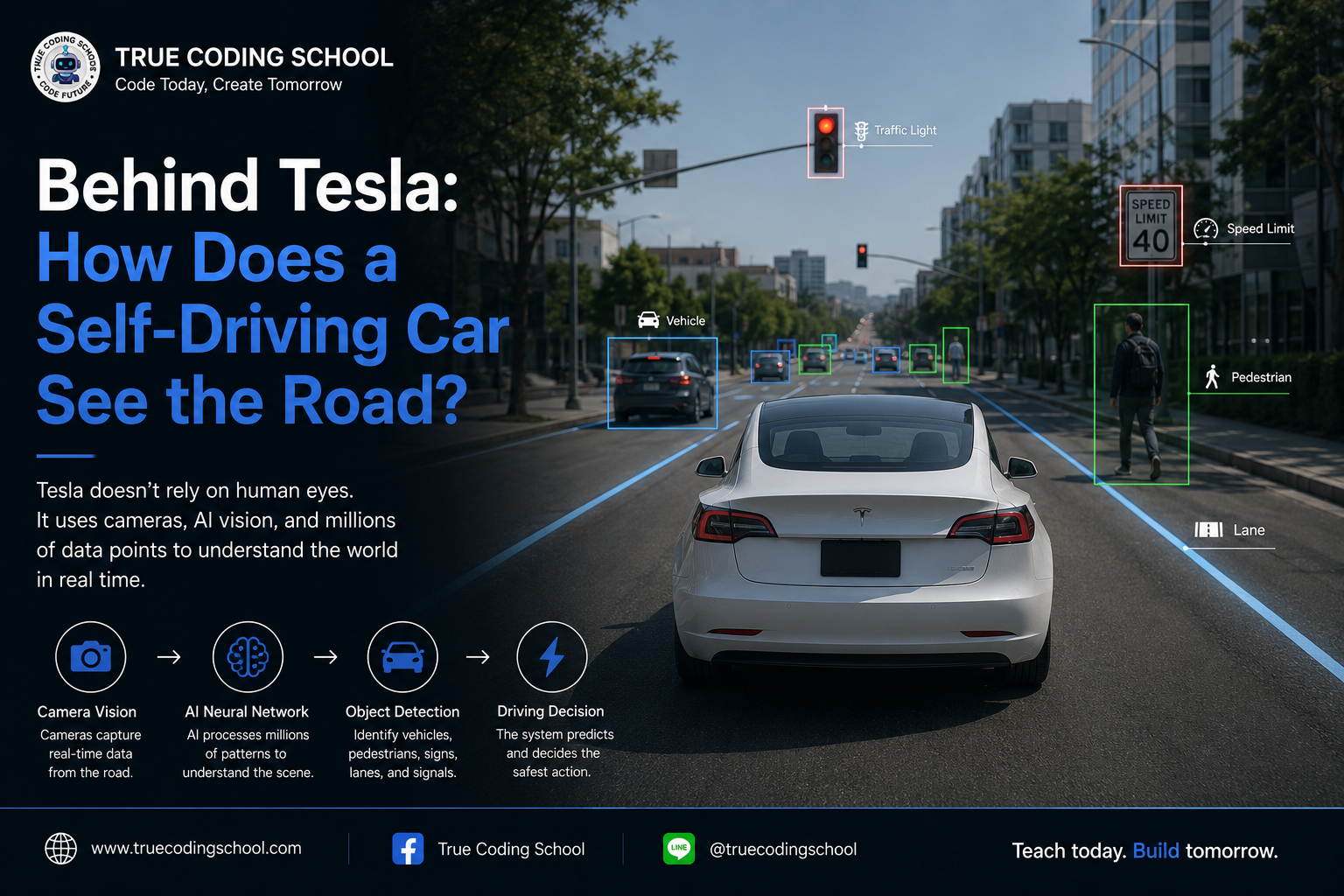
When you watch a Tesla drive itself, it almost looks like magic.
The car stays in its lane, recognizes traffic lights, slows down for other vehicles, and even changes lanes in certain situations.
But here's the fascinating part:
A self-driving car doesn't actually "see" the road the way humans do.
Instead, it constantly collects information, processes it, and makes thousands of decisions every second using cameras, artificial intelligence, and powerful computers.
Every Drive Starts With Observation
Before a Tesla can make any decision, it first needs to understand what's happening around it.
To do this, the vehicle uses multiple high-resolution cameras positioned around the car, giving it a nearly 360-degree view of its surroundings.
These cameras continuously capture images of:
🚗 Other vehicles
🚶 Pedestrians
🚦 Traffic lights
🛑 Road signs
🛣️ Lane markings
🚲 Cyclists
Everything the cameras detect is instantly sent to the car's onboard computer for analysis.
AI Doesn't See—It Recognizes Patterns
Unlike humans, AI doesn't understand roads through experience or intuition.
Instead, it has been trained using millions of real driving situations.
The system learns to recognize patterns, allowing it to identify objects and predict what might happen next.
For example, the AI can recognize that:
A red octagonal sign means "Stop."
A pedestrian standing near a crosswalk may begin crossing.
A bicycle moving close to the lane requires extra caution.
A traffic light changing from green to yellow means it's time to prepare to slow down.
This ability is powered by machine learning, where AI improves by learning from enormous amounts of driving data.
Thousands of Decisions Every Second
Driving isn't just about seeing.
It's about making decisions.
Every second, a self-driving system asks questions like:
• Is another car slowing down?
• Is someone about to cross the street?
• Should I stay in this lane?
• Is it safe to turn?
• How fast should I be driving?
The onboard computer processes all of this information almost instantly, helping the vehicle react much faster than humans can in many situations.
Robotics in the Real World
A self-driving car is one of the best examples of robotics in action.
Just like any robot, it follows a simple cycle:
👀 Sense – Cameras gather information.
🧠 Think – AI analyzes the situation.
⚙️ Act – The car steers, accelerates, or brakes.
This same idea appears in many robotics projects.
A small robot that avoids obstacles uses sensors.
An automated door detects movement before opening.
Even a line-following robot follows the same principle of sensing, thinking, and acting.
The technology may be different, but the engineering process is remarkably similar.
Why This Matters for Children
Many children are fascinated by self-driving cars because they represent the future of technology.
But behind every autonomous vehicle are skills that can be learned step by step.
Programming.
Electronics.
Artificial Intelligence.
Robotics.
Problem-solving.
Every great engineer starts by understanding these building blocks before creating something much bigger.
From Classroom Projects to Future Innovation
At True Coding School Phuket, students don't just learn how to write code.
They explore how technology works behind the scenes through hands-on projects in Robotics, AI, Programming, and Engineering.
Whether they're programming a robot to avoid obstacles, building an AI-powered project, or learning how sensors communicate with a microcontroller, they're developing the same logical thinking used in many of today's most advanced technologies.
Because every innovation—from a simple robot to a self-driving car—begins with one question:
"How does it work?"
And that's where learning truly begins.