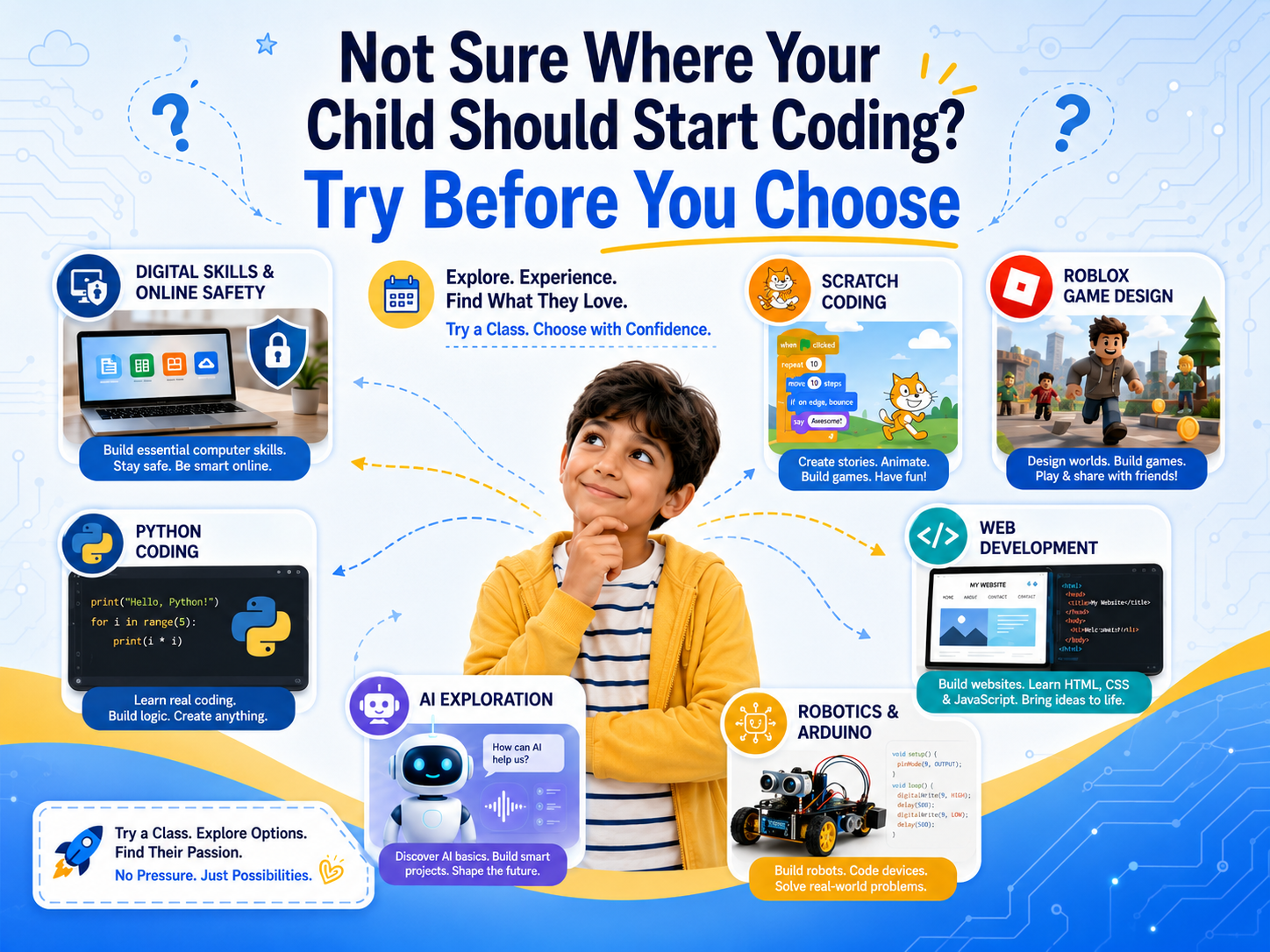
Not Sure Where Your Child Should Start Coding? Try Before You Choose
Choosing the right coding course for your child can feel completely overwhelming at first. With so many buzzwords, technologies, and marketing promises flying around, parents easily find themselves trapped in a loop of endless, confusing questions:
Should they start with Scratch or dive straight into Python?
Would they actually learn anything from Roblox, or is it just another distraction?
Are they ready for Robotics, Web Development, or Artificial Intelligence?
The truth that every educator knows is simple: every single child is uniquely wired. Some children love telling vibrant visual stories, some thrive on cold analytical logic, while others need to physically touch and build physical objects to understand how things work. Guessing their perfect tech path from a brochure rarely works, and forcing a child into the wrong language can quickly crush their natural interest. The single best way to choose a coding course is not by guessing—it is by letting your child try it firsthand.
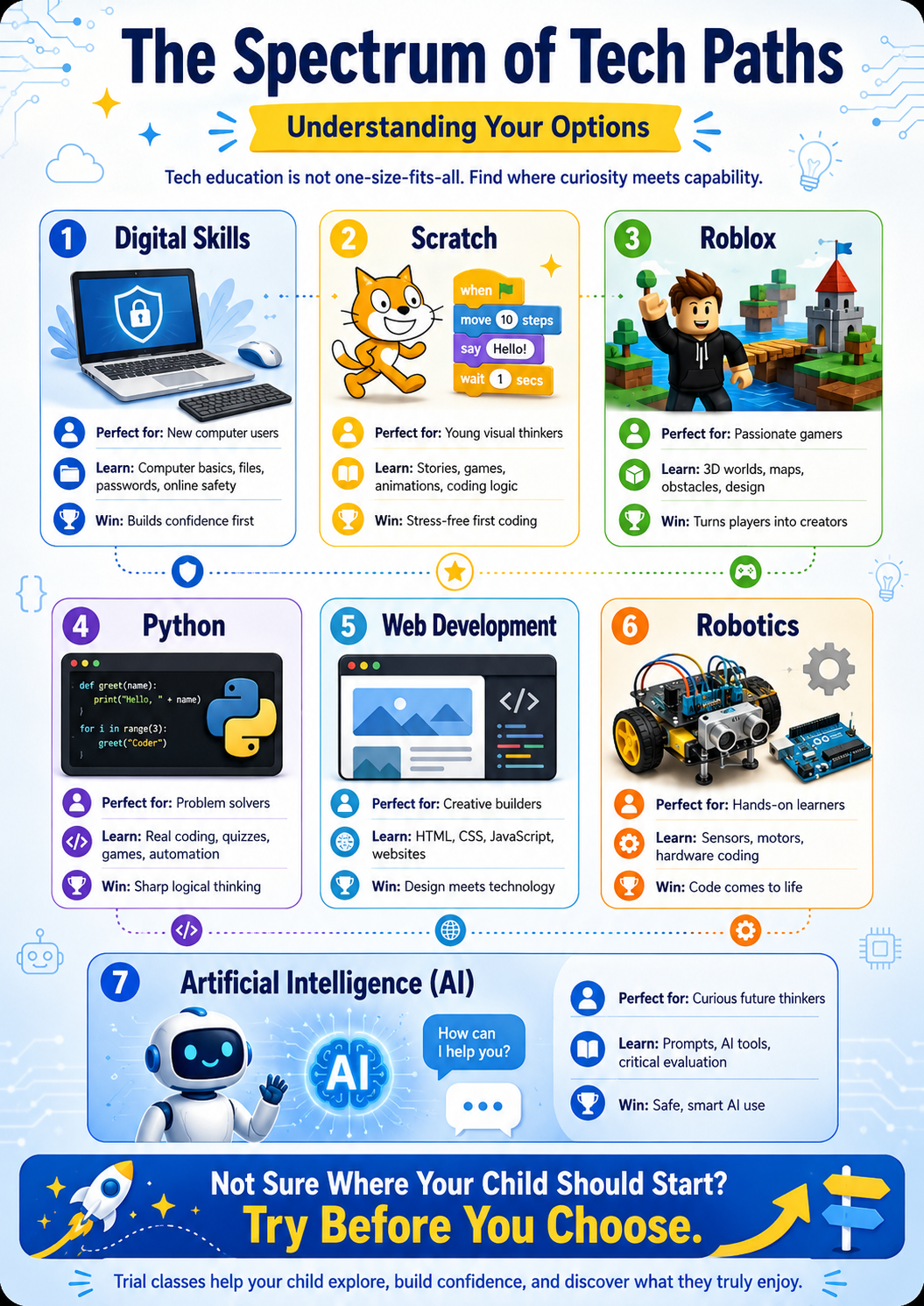
🧩 The Spectrum of Tech Paths: Understanding Your Options
To help you navigate the digital landscape, we have broken down our core educational programs based on your child's natural learning style, interests, and current confidence levels. Tech education is not one-size-fits-all; it is about finding where curiosity meets capability.
1. Digital Skills: Building Fundamental Confidence
The Perfect Target: This pathway is specifically designed for children who are brand new to computers or need to build basic keyboard, mouse, and operating system confidence before diving into programming languages.
The Deep-Dive Curriculum: Students learn the essential digital habits that schools often skip over. This includes mastering proper computer navigation, setting up structured file organization, learning safe online behavior, creating unhackable passwords, and developing a foundational awareness of modern cybersecurity concepts.
The Psychological Win: This course removes the initial anxiety of using technology, transforming a tentative user into a confident digital explorer who is ready for advanced tracks.
2. Scratch: Perfect for Young, Visual Thinkers
The Perfect Target: Ideal for younger beginners who naturally gravitate toward drawing, imagination, character design, and interactive storytelling.
The Deep-Dive Curriculum: Scratch completely eliminates the frustration of typing out syntax errors by using colorful, interlocking drag-and-drop code blocks. Students focus entirely on the pure logic of creation, building their own custom games, animated stories, and interactive cartoon characters.
The Psychological Win: It introduces core computer science principles—such as loops, variables, sequencing, and conditional events—in a purely visual, stress-free environment where mistakes are easy to fix and fun to learn from.
3. Roblox: For the Passionate Gamers
The Perfect Target: Perfect for children and teens who already spend hours playing inside the Roblox ecosystem and want to discover the secrets behind how those digital worlds are built.
The Deep-Dive Curriculum: This path completely flips the script from passive gaming to active, high-level engineering. Students learn how to step into the shoes of a game designer, mastering 3D world-building, custom map creation, obstacle course architecture, and structural design.
The Psychological Win: By leveraging an existing hobby, it serves as an incredibly powerful motivational bridge that transforms gaming addiction into a deep passion for digital creation and spatial logic.
4. Python: Real-World Text Coding for Problem Solvers
The Perfect Target: Perfect for older students, natural problem solvers, puzzle enthusiasts, and children who display a strong affinity for mathematics, structured logic, and step-by-step challenges.
The Deep-Dive Curriculum: Python is one of the most widely used, professional programming languages on earth, celebrated for its clean, readable, and beginner-friendly syntax. Students learn to type actual, production-grade code to build functional calculators, interactive text-based adventure games, algorithmic quizzes, and automation scripts.
The Psychological Win: It trains the mind to think with absolute precision, forcing students to troubleshoot logical errors systematically and preparing them directly for advanced computer science and software engineering.
5. Web Development: For Creative Digital Builders
The Perfect Target: Perfect for creative individuals who want to build tangible, functional projects that they can instantly publish and share with friends and family across the global internet.
The Deep-Dive Curriculum: Students pull back the curtain on the worldwide web, mastering the foundational languages of the modern internet: HTML for structural bones, CSS for visual styling, colors, and layouts, and JavaScript for interactive elements and dynamic features. They learn to build custom personal websites, digital landing pages, and portfolio showcases.
The Psychological Win: It beautifully merges artistic design choices with rigorous technical implementation, teaching students exactly how user interfaces and internet architectures operate in reality.
6. Robotics: For Dynamic, Hands-On Learners
The Perfect Target: Ideal for kinetic learners, children who love playing with building blocks, gadgets, or machinery, and those who learn best by physically manipulating objects in the real world.
The Deep-Dive Curriculum: Robotics bridges the massive gap between the digital screen and physical reality. Students learn how to write instructions that control physical hardware, exploring the mechanics of electronic sensors, electric motors, physical movement patterns, and Arduino-style hardware coding to complete real-world engineering missions.
The Psychological Win: It shows students the immediate, physical consequences of their code, teaching them how to test, iterate, and experiment relentlessly when a machine doesn't behave as expected.
7. Artificial Intelligence (AI): For Curious Future Thinkers
The Perfect Target: Designed for highly inquisitive minds who are fascinated by smart technology and want to understand the modern tools that are actively reshaping every global industry.
The Deep-Dive Curriculum: This path demystifies machine learning. Students explore exactly how AI makes complex decisions, how to craft highly optimized prompts (Prompt Engineering), how to build creative AI-assisted projects, and how to evaluate machine output critically and skeptically.
The Psychological Win: It shifts your child from a casual user of AI tools into an ethical, highly skilled director of AI, emphasizing critical thinking, safety, and human-machine collaboration.
📊 Quick Reference Comparison Matrix
If your child naturally loves... | Their biggest educational need is... | The ideal matching pathway is... |
Playing competitive video games | To discover how games are engineered | Roblox Game Design |
Drawing, cartoons, and storytelling | Visual logic without typing syntax stress | Scratch Visual Coding |
Solving riddles, mathematics, and puzzles | Text-based coding and architectural logic | Python Programming |
Graphic design, art, layouts, and colors | Building beautiful, public internet pages | Web Development |
Building with Legos, taking gadgets apart | Connecting code to moving physical objects | Robotics Engineering |
Questioning how future tech works | Learning to direct smart machine models | Artificial Intelligence (AI) |
Browsing videos or clicking around | Overcoming basic computer anxiety & safety | Digital Skills Foundation |
🚀 The Power of a Trial Class: Ending the Guesswork
"Coding is not merely a technical skill about typing syntax; it is an elite mental framework for breaking down massive problems, recognizing hidden patterns, and building creative solutions out of nothing."
Because technology education is deeply personal, forcing a child into a rigid path that does not align with their organic cognitive style can inadvertently cause them to turn away from technology altogether. This is exactly why a trial class changes everything.
During a trial session, experienced instructors don't simply lecture from a script—they actively observe. They analyze how your child naturally approaches an unfamiliar obstacle, whether they respond better to visual block logic or structured text commands, and exactly which activity causes their eyes to light up with genuine excitement. By letting your child try before you choose, you strip away the stressful guesswork and allow their natural curiosity to chart the course. When a student finds the exact tech path that matches their inner personality, learning stops feeling like homework and begins feeling like an adventure.
🌌 Discover Your Child's True Path at True Coding School Phuket
You do not have to make this massive decision alone, and you don't have to guess what your child's future look like today. Let them explore, let them experiment, and let them discover what truly inspires them. Get in touch with our educational team at True Coding School Phuket to book a personalized, hands-on trial session and help your child find the digital path they will truly love:
📞 Phone: +66 62 086 7916
💬 Line ID:
Truecoding.phuket✉️ Email: info.truecodingschool@gmail.com
📍 Address: 65/31 Moo 2, Chaofa-Suanluang Road, Vichit, Muang, Phuket 83000, Thailand