
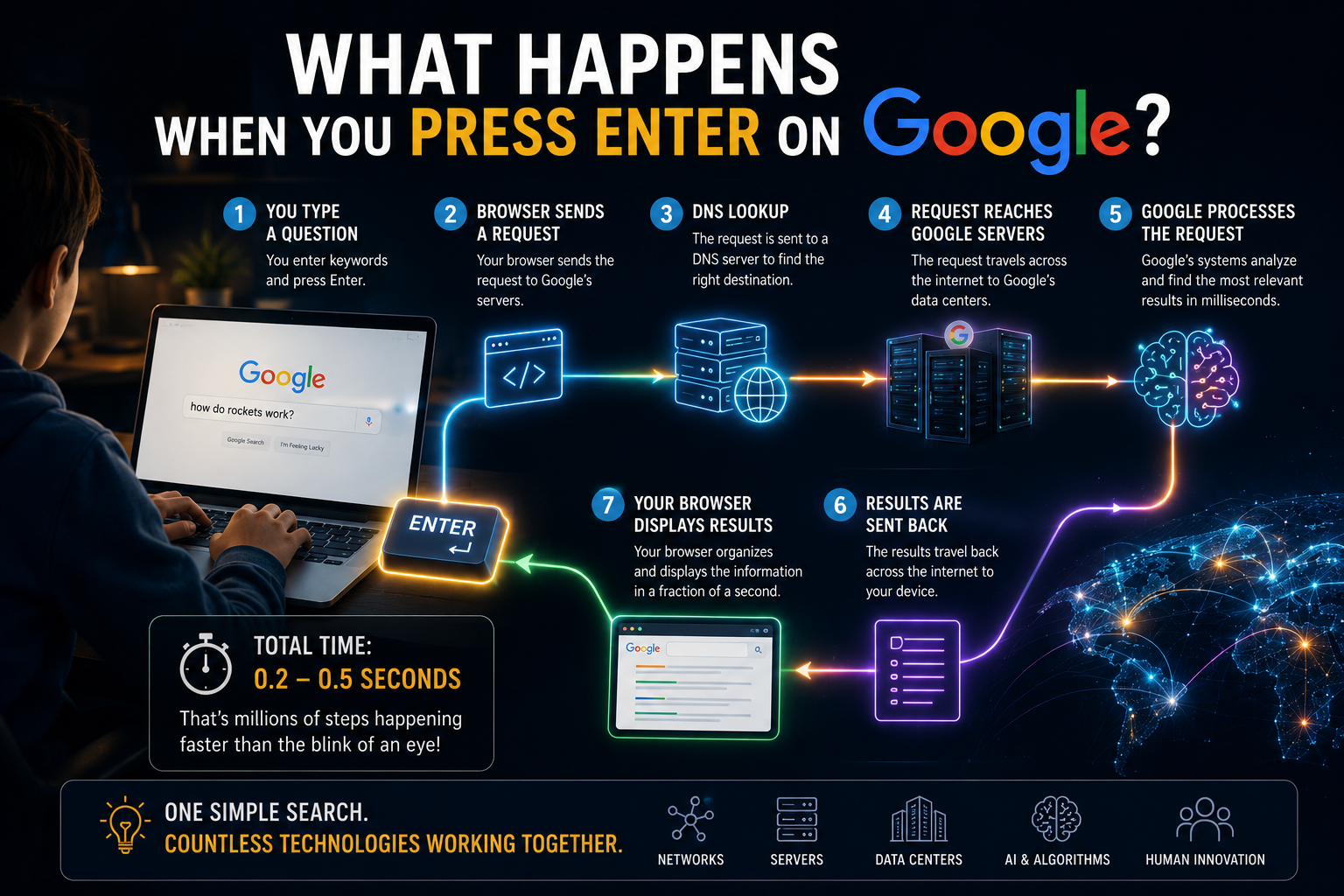
What Happens When You Press Enter On Google?
It is perhaps the most repeated human action of the twenty-first century. You sit at your desk, type a burning question or a single keyword into the clean white search bar, and slam the Enter key. In less than a quarter of a second, a beautifully ranked universe of knowledge appears on your screen.
To the average user, it feels instant, almost mundane. But underneath that simple keystroke lies an incredibly dramatic, high-speed digital odyssey. From the physical micro-switches in your keyboard to the massive, subterranean data centers humming across the globe, pressing enter triggers a synchronized symphony of modern engineering.
Here is the step-by-step journey of what actually happens in that blink of an eye.
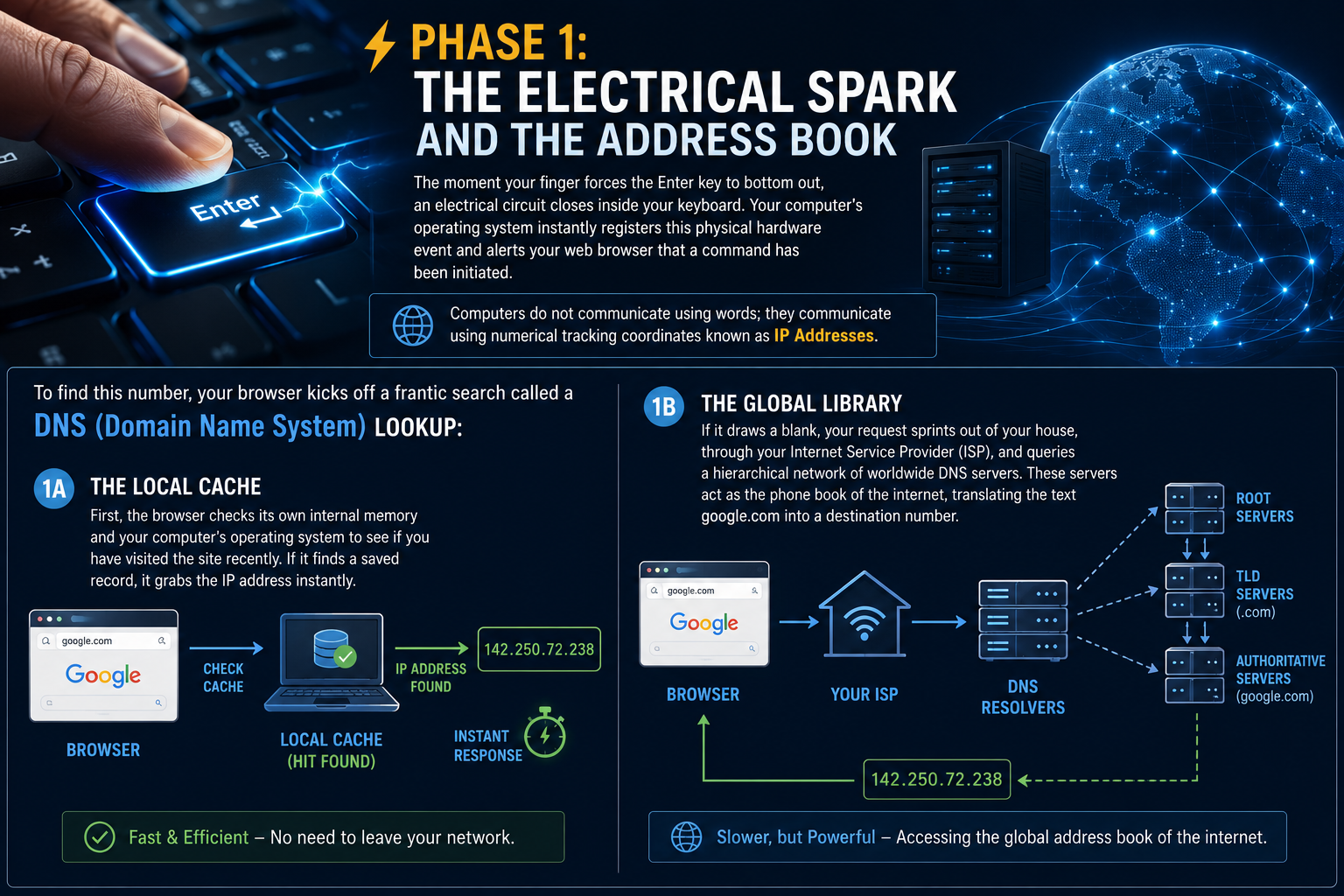
⚡ Phase 1: The Electrical Spark and the Address Book
The moment your finger forces the Enter key to bottom out, an electrical circuit closes inside your keyboard. Your computer's operating system instantly registers this physical hardware event and alerts your web browser that a command has been initiated.
Your browser looks at what you wrote. If you typed a specific web address like google.com, the browser realizes it has a human-friendly name but no idea where it actually lives on the planet. Computers do not communicate using words; they communicate using numerical tracking coordinates known as IP Addresses.
To find this number, your browser kicks off a frantic search called a DNS (Domain Name System) Lookup:
The Local Cache: First, the browser checks its own internal memory and your computer's operating system to see if you have visited the site recently. If it finds a saved record, it grabs the IP address instantly.
The Global Library: If it draws a blank, your request sprints out of your house, through your Internet Service Provider (ISP), and queries a hierarchical network of worldwide DNS servers. These servers act as the phone book of the internet, translating the text
google.cominto a destination number.
🔒 Phase 2: Racing Across the Web and Shaking Hands
Once the correct IP address is secured, your browser must establish a reliable highway to get to Google’s physical data center. It uses a core protocol stack known as TCP/IP (Transmission Control Protocol / Internet Protocol).
Data is chopped up into tiny, digital envelopes called packets. These packets bounce across local routers, fiber-optic underwater cables, and massive network switches at near the speed of light to reach Google’s front door.
Before any sensitive search queries can be handed over, security is paramount. Because Google uses HTTPS, your browser performs a secure cryptographic dance called a TLS/SSL Handshake. The browser and Google’s servers exchange security certificates and secret cryptographic keys. This ensures that whatever you are searching for is entirely encrypted inside a secure digital vault, completely unreadable to any hackers trying to spy on your Wi-Fi network.
🛡️ Phase 3: Passing the Gates and Distributing the Crowd
When your encrypted data packets arrive at a Google data center, they hit a wall of defensive security systems known as Firewalls. These systems analyze the incoming traffic in microseconds to make sure you are an actual human looking for information and not a malicious cyber-attack trying to crash the system.
Once approved, your request meets the air traffic controllers of the internet: Load Balancers.
Google handles billions of searches every single day. If every user hit the exact same machine, the infrastructure would burst into digital flames. Load balancers analyze the health, capacity, and physical proximity of thousands of servers inside the server farm, instantly routing your individual request to the most available, optimal machine.
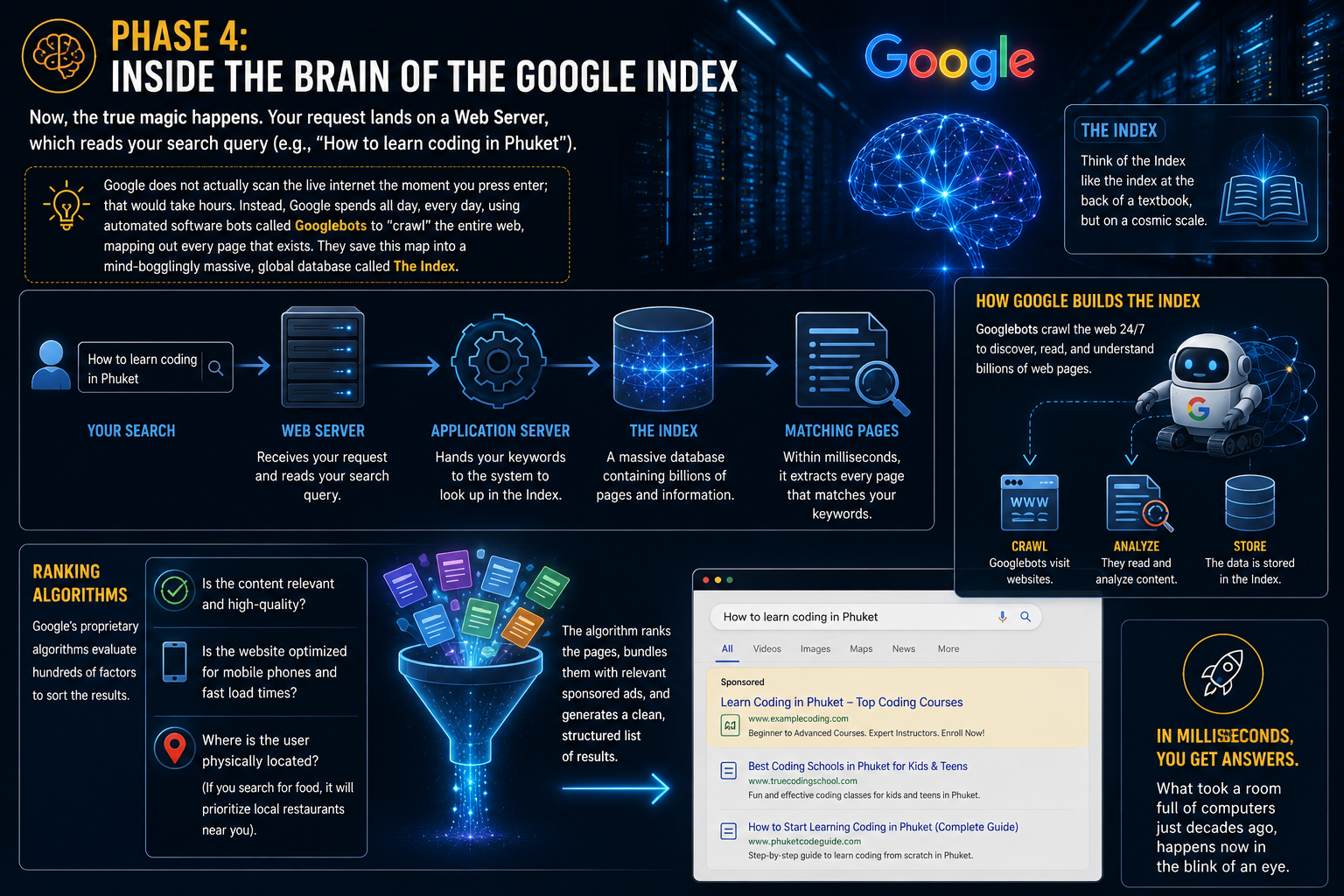
🧠 Phase 4: Inside the Brain of the Google Index
Now, the true magic happens. Your request lands on a Web Server, which reads your search query (e.g., "How to learn coding in Phuket").
Google does not actually scan the live internet the moment you press enter; that would take hours. Instead, Google spends all day, every day, using automated software bots called Googlebots to "crawl" the entire web, mapping out every page that exists. They save this map into a mind-bogglingly massive, global database called The Index.
Think of the Index like the index at the back of a textbook, but on a cosmic scale. The web server hands your keywords to an application server, which immediately looks up the words in the Index. Within milliseconds, it extracts a list of every single web page on earth containing those words.
Next, Google's proprietary Ranking Algorithms take over. The algorithm evaluates hundreds of hidden factors to sort the raw data:
Is the content relevant and high-quality?
Is the website optimized for mobile phones and fast load times?
Where is the user physically located? (If you search for food, it will prioritize local restaurants near you).
The algorithm ranks the pages, bundles them with relevant sponsored ads, and generates a clean, structured list of results.
🏗️ Phase 5: Painting the Screen
The application server hands this freshly minted list back to the web server, which packages the data into standard web languages: HTML, CSS, and JavaScript.
This package is shot back through the load balancers, past the firewalls, back down the international fiber-optic lines, and straight into your device.
Your web browser receives the raw structural code and instantly acts as a digital artist. It reads the HTML to form the bones of the page, applies the CSS to style the fonts and colors, and executes the JavaScript to make the buttons interactive.
The Search Engine Results Page (SERP) materializes beautifully on your monitor.
🚀 Unleash the Mind Behind the Machine at True Coding School
Every single step of this jaw-dropping sequence—from packet routing and TLS handshakes to algorithm design and database indexing—was conceptualized, architected, and built by software engineers. They are the creators who look at the chaos of the world and use code to build order, speed, and magic.
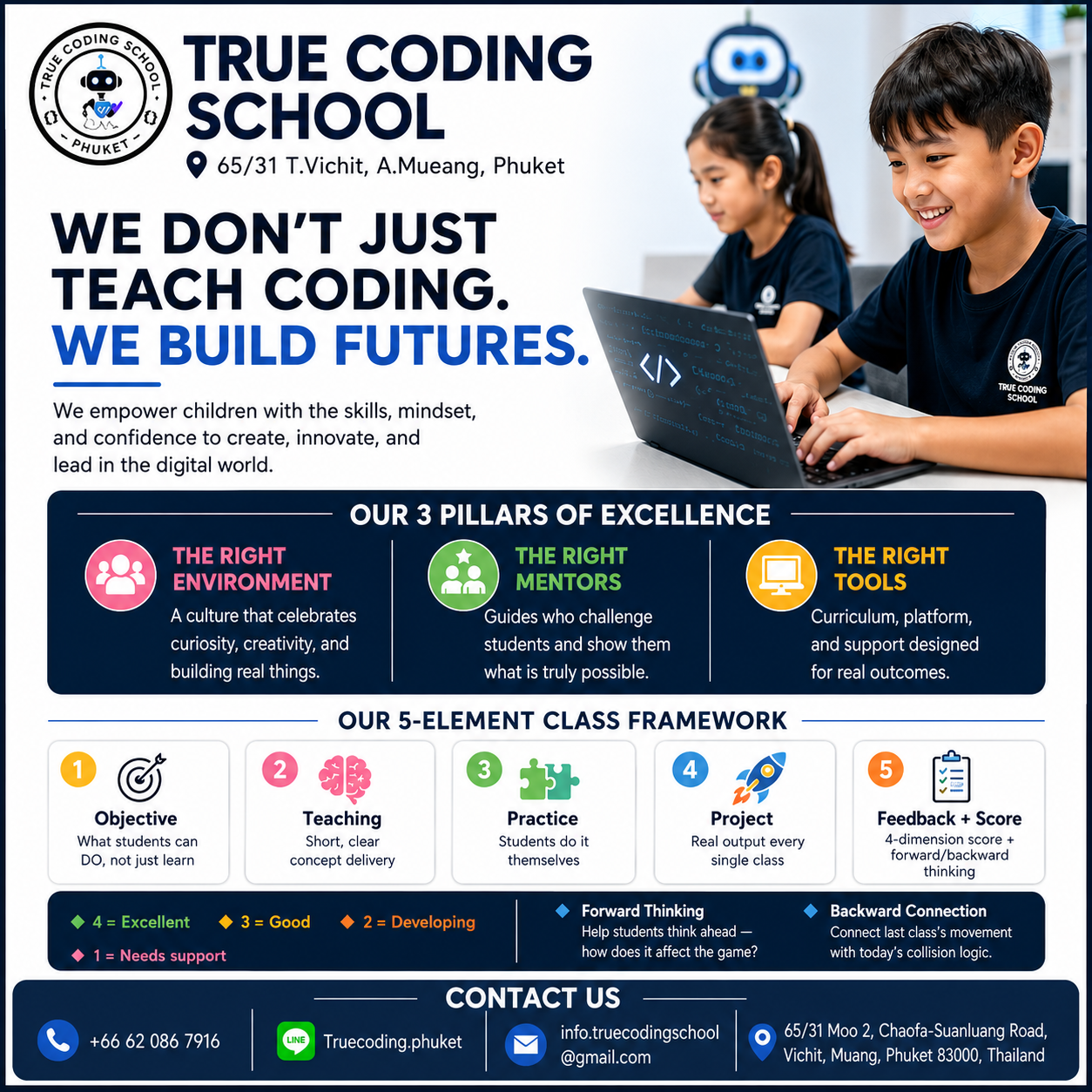
At True Coding School, we believe that understanding how the digital world works is the ultimate superpower of the modern century. We don't want your child to just be a passive user who presses enter and stares at the results. We want to train them to be the innovators who design the systems behind the screen.
Through our hands-on, Project-Based Learning approach, students learn to master Computational Thinking—the foundational logic of problem-solving, algorithm architecture, and system design that powers global giants like Google. Whether they are taking their first steps into logic or aiming to build real-world applications, we give them the launchpad to transition from technology consumers to tomorrow's tech creators.
The digital future belongs to those who know how to build it. Start your journey with us today.
📞 Connect with True Coding School
Ready to transform curious screen time into structured tech mastery? Reach out to our admissions team at True Coding School Phuket to explore our elite programs:
📞 Phone: +66 62 086 7916
💬 Line ID:
Truecoding.phuket✉ ... Email: info.truecodingschool@gmail.com
📍 Address: 65/31 Moo 2, Chaofa-Suanluang Road, Vichit, Muang, Phuket 83000, Thailand