Can Children Learn AI?
The Answer Might Surprise You
Artificial Intelligence is everywhere. From ChatGPT and Google Gemini to AI-powered search engines and image generators, AI has quickly become one of the most talked-about technologies in the world.
Many parents are now asking an important question: Should my child be learning AI?
At first, the answer might seem obvious. AI sounds complicated. Many adults assume it is something only software engineers, data scientists, or university students can understand. But the truth may surprise you: Children can absolutely begin learning AI—and many are capable of doing so much earlier than most people think.
The key is understanding what AI education should actually look like.
AI Is Not Just About Programming
When many people hear the phrase "Artificial Intelligence," they imagine complex neural networks, advanced mathematics, and endless lines of code. While those topics are certainly part of AI at higher levels, they are not where children begin.
Learning AI for children is less about building the next ChatGPT and more about understanding how intelligent tools work, how to use them responsibly, and how to think critically when interacting with technology. Just as children learn how to read books before they write novels, they can learn how AI works before they build advanced AI systems.
Children Already Use AI Every Day
Many parents are surprised to discover that their children interact with AI regularly. Examples include:
🗣️ Voice assistants like Siri and Google Assistant
📺 YouTube and Netflix recommendation algorithms
🔍 AI-powered search tools
🤖 ChatGPT and conversational AI
🎨 Image generation tools
The question is no longer whether children will encounter AI. The question is whether they will understand it.
The Real Risk Is Not Learning AI
Some parents worry that AI might make children lazy. However, the greater risk may be the opposite. Children who grow up using AI without understanding it may struggle to evaluate information, identify mistakes, or use technology effectively.
AI is becoming a core tool that will be used across nearly every profession. When we combine Human Expertise with AI Capabilities, we unlock the formula for the future-ready professional.
Profession | How They Use AI |
Doctors | To detect diseases early and analyze medical scans. |
Engineers & Architects | To test structural designs and optimize materials. |
Business Owners | To automate routine tasks and analyze market data. |
Designers & Artists | To brainstorm visual concepts and speed up workflows. |
Future professionals will not compete against AI. They will work alongside it. Teaching children how to use AI wisely helps prepare them for that future.
What Should Children Actually Learn About AI?
A great AI education program is not focused on memorizing technical terminology. Instead, it develops essential future-ready skills:
1. Critical Thinking
One of the most important lessons children learn is that AI is not always correct. Students learn to ask:
Is this answer accurate?
Where did this information come from?
Does this make sense?
Learning to question AI is just as important as learning to use it.
2. Communication
AI responds to instructions. The clearer the instruction, the better the result. In the world of AI, we model this relationship simply:
This means students learn how to communicate clearly and effectively. They learn how to explain ideas, ask better questions, and think carefully about the information they need. Ironically, learning AI often improves human communication skills.
3. Creativity
Many people assume AI reduces creativity. In reality, AI can become a powerful creative partner. Students can use AI to:
Generate story ideas
Design characters
Brainstorm projects
Create artwork & build game concepts
The most exciting creations often come from combining human imagination with AI tools.
4. Problem Solving
At its core, AI is a tool. Students learn how to use that tool to solve challenges and create meaningful projects. Whether they are building a game, designing a website, or creating a presentation, AI can help them work more efficiently while encouraging deeper thinking.
AI Literacy: The New Foundation
For generations, reading, writing, and mathematics have formed the foundation of education. Today, AI literacy is joining them as an equally critical core skill, creating a well-rounded foundation for 21st-century learning alongside traditional subjects.
What does AI Literacy actually mean?
Understanding what AI is and how it works.
Knowing what AI can and cannot do.
Learning to use AI tools safely and responsibly.
Maintaining a critical mindset when evaluating AI outputs.
From AI Users to AI Creators
Most people will simply use AI. Far fewer people will know how to create with AI. The difference is significant:
An AI User asks questions.
An AI Creator builds solutions.
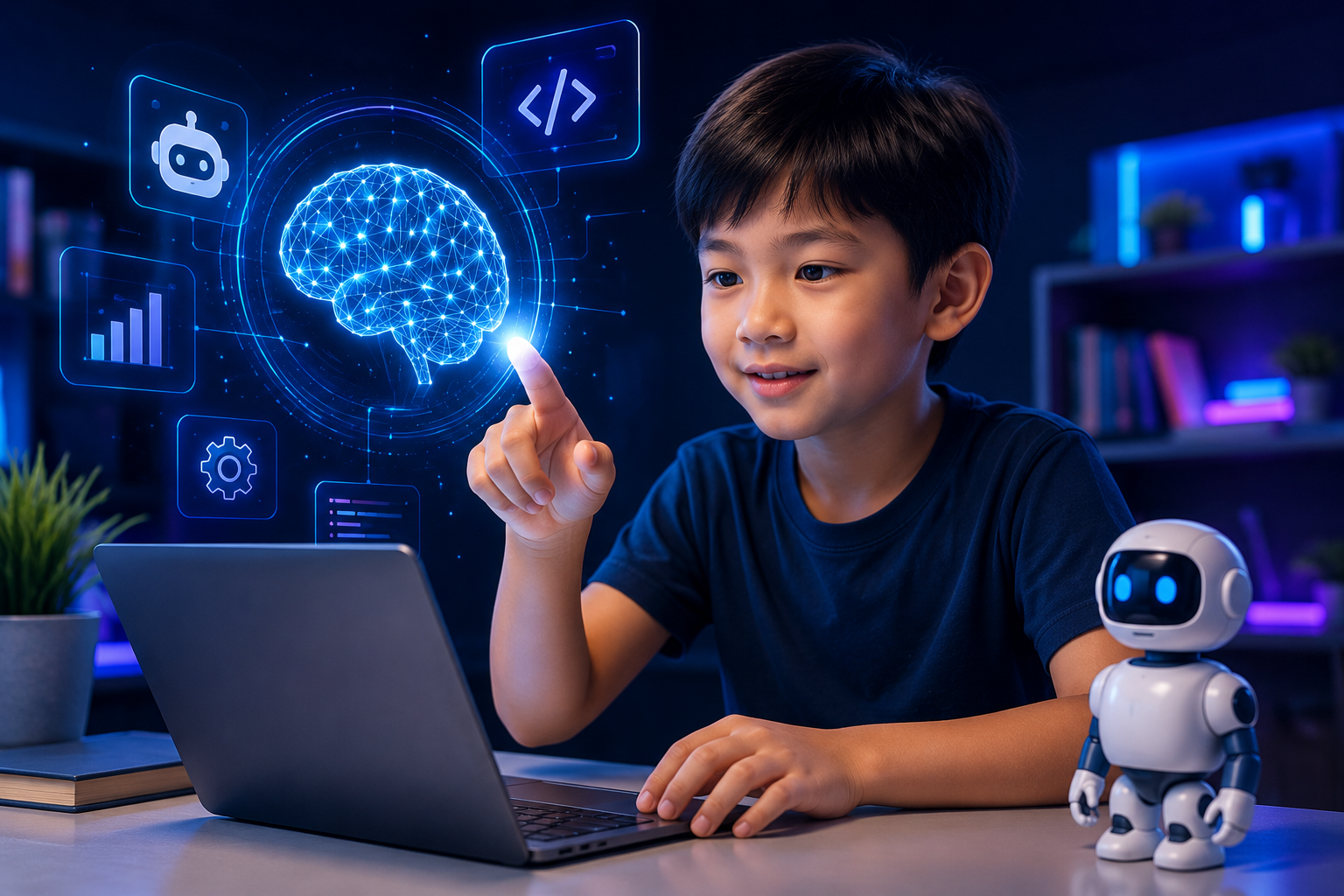
Children who transition from users to creators can leverage AI to build games, design websites, program chatbots, and solve real-world problems. The future belongs not only to those who consume technology, but also to those who create it.
How We Teach AI at True Coding School
At True Coding School, we believe AI education should be practical, creative, and age-appropriate. Our curriculum ensures students learn how to:
✔ Understand what AI is and how it works under the hood.
✔ Write highly effective, structured prompts.
✔ Evaluate and fact-check AI-generated information.
✔ Build tangible, creative projects using AI assistance.
Most importantly, we teach students that AI is a tool—not a replacement for human thinking. The goal is not to let AI think for them; the goal is to help students think better.
Final Thoughts
So, can children learn AI? Absolutely.
In fact, many already interact with AI every day without realizing it. The real opportunity is helping children move beyond simply using AI and begin understanding how it works, how to question it, and how to create with it.
The future will belong to people who can combine technology with creativity, critical thinking, and problem solving. Those are exactly the skills children can begin developing today.
And that answer may surprise more people than you think.
Contact Us
If you have any questions about our AI and coding programs, feel free to reach out to us:
📞 Phone: +66 62 086 7916
💬 Line: Truecoding.phuket
✉️ Email: info.truecodingschool@gmail.com
📍 Address: 65/31 Moo 2, Chaofa-Suanluang Road, Vichit, Muang, Phuket 83000, Thailand