We live in a world where technology is no longer just a sector of the economy it is the basic infrastructure of human life. Yet, when parents hear terms like "computer science," "software development," or "coding classes," they almost always jump to the same conclusion:
🛑 "My child doesn't want to be a software engineer, so they don’t need to spend time learning this."
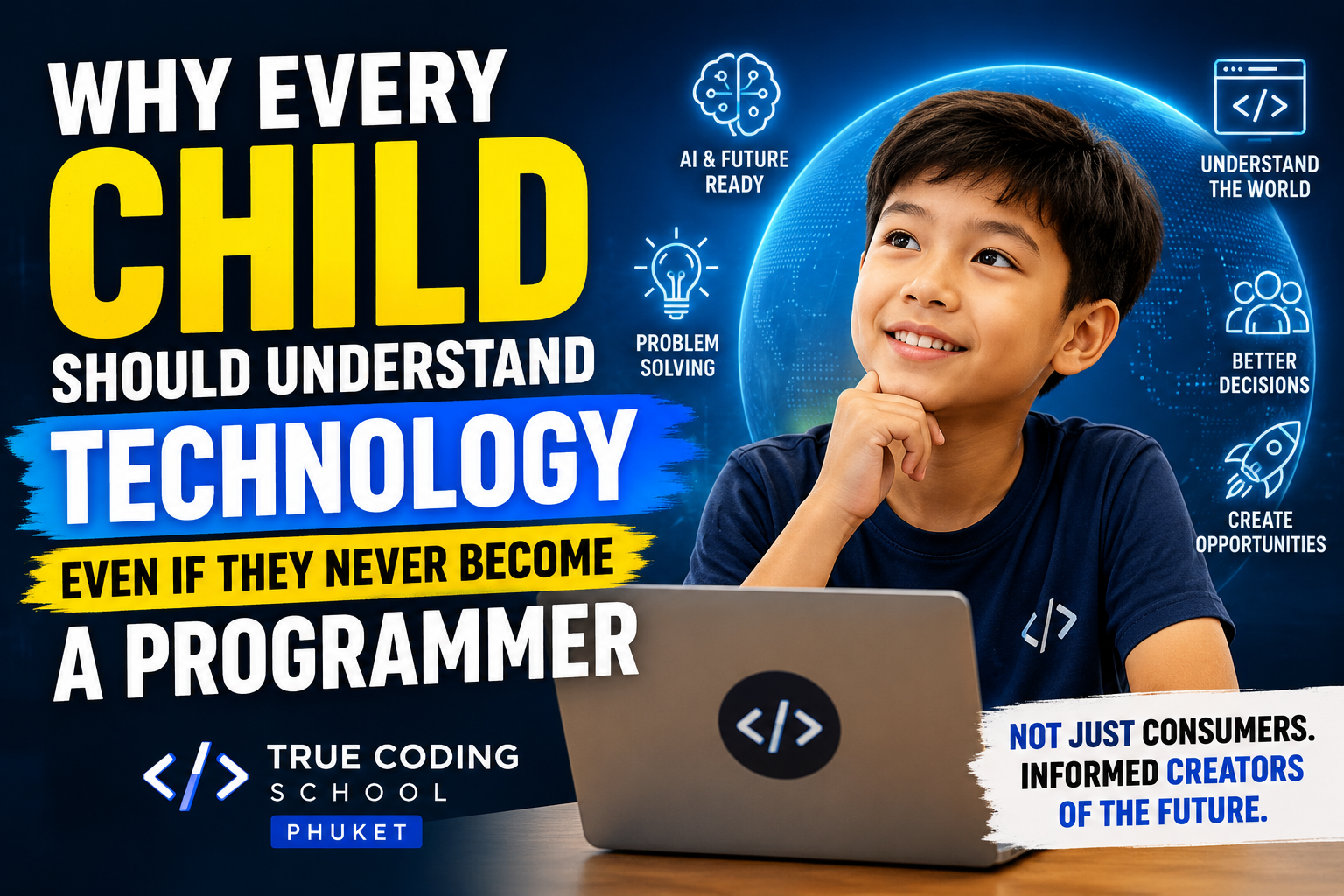
This is one of the single greatest misunderstandings in the modern educational landscape. Teaching a child how technology works isn't about forcing them into a career writing code for Silicon Valley tech giants. It is about giving them the keys to understand, navigate, and control the world they inhabit.
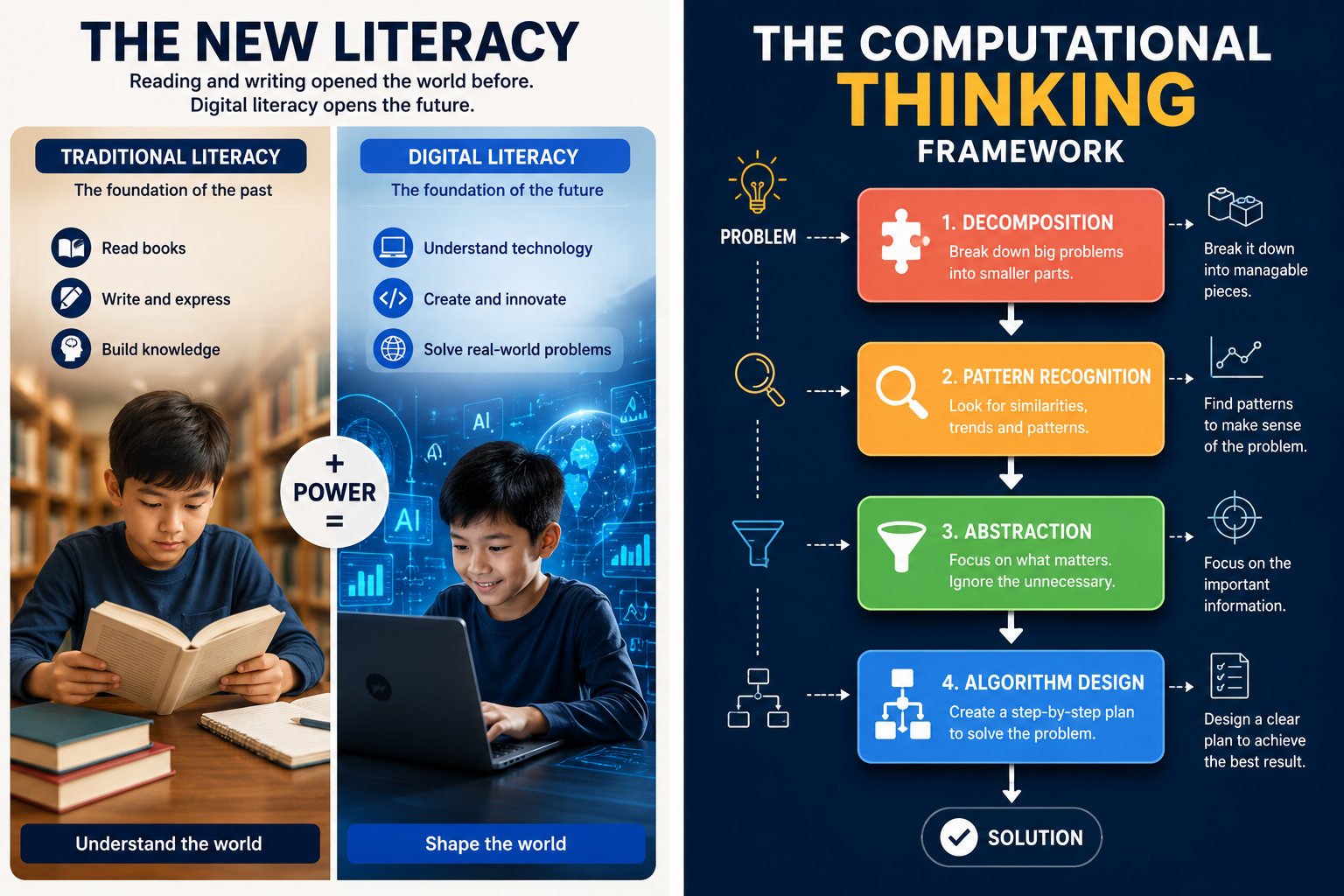
Consider this perspective: We teach children biology not because we expect them all to become doctors, and we teach them geometry not because they will all become professional architects. We teach them these subjects to give them a baseline literacy of reality. Today, the world is fundamentally digital. Expecting a child to navigate the modern economy without understanding computer science is like sending them into a library without knowing how to read. Digital literacy is no longer elective; it is survival.
🛠️ The Invisible Superpower: Computational Thinking
When a child learns to program or interact deeply with technology, they aren't just learning how to type syntax like if/else statements, variables, or arrays. They are training their brain in a highly sophisticated, universal problem-solving methodology known as Computational Thinking.
This cognitive framework strips away the fear of the unknown and breaks down into four invaluable life skills that apply to any professional field:
💡 THE COMPUTATIONAL THINKING FRAMEWORK
 │
 ├── 🧭 Decomposition ──────> Breaking massive, terrifying problems down into tiny, actionable steps.
 │
 ├── 🔍 Pattern Recognition ─> Identifying similarities, historical trends, and repeating structures.
 │
 ├── 📐 Abstraction ─────────> Stripping away irrelevant noise to focus entirely on what truly matters.
 │
 └── ⚙️ Algorithm Design ────> Creating an flawless, step-by-step blueprint to achieve a predictable result.
How this applies across different careers:
The Lawyer: Uses decomposition and pattern recognition to slice through thousands of pages of legal precedents, isolating the single hidden anomaly that wins the case.
The Doctor: Uses abstraction to look past a dozens of conflicting symptoms, focusing strictly on the core physiological breakdown to accurately diagnose a rare disease.
The Artist: Uses algorithmic logic to orchestrate intricate digital workflows, manage assets, and utilize state-of-the-art software tools to manifest their creative vision.
The Entrepreneur: Treats their entire logistics pipeline as a program, optimizing inputs and outputs to scale a business without structural failure.
💼 The Tech-Informed Professional: Surviving the Automations of 2030
The line separating "tech jobs" from "non-tech jobs" has not just blurred it has completely vanished. Every major industry is currently undergoing a massive structural transformation. Look at how traditional roles have rapidly evolved, and where they are heading in the near future:
Career Path | The Traditional Way | The New Digital Reality |
🎨 Graphic Designer | Sketch pads, static layout tools, and physical print proofs. | Generative AI prompt pipelines, real-time 3D rendering engines, and interactive UX/UI frameworks. |
📊 Business Analyst | Manual spreadsheets, standard desktop calculators, and paper reports. | SQL data query architectures, custom Python automation scripts, and real-time dashboard data models. |
🩺 Healthcare Professional | Manual paper charts, physical file storage, and subjective observation. | Cloud-integrated digital health arrays, AI-driven diagnostic assistance, and robotic surgical interfaces. |
📈 Marketing Specialist | Traditional billboard placements, print ads, and legacy television spots. | Hyper-targeted programmatic advertising, behavioral data tracking, and real-time conversion funnel metrics. |
If a professional entering the workforce tomorrow does not understand the underlying logic of algorithms, automation loops, and data streams, they won't just lag behind they will find themselves entirely locked out of high-level strategy. Technology literacy transforms a child from a passive operator managed by machines into an active director who commands them.
🛡️ Digital Sovereignty: Moving Past "Magic" and Manipulation
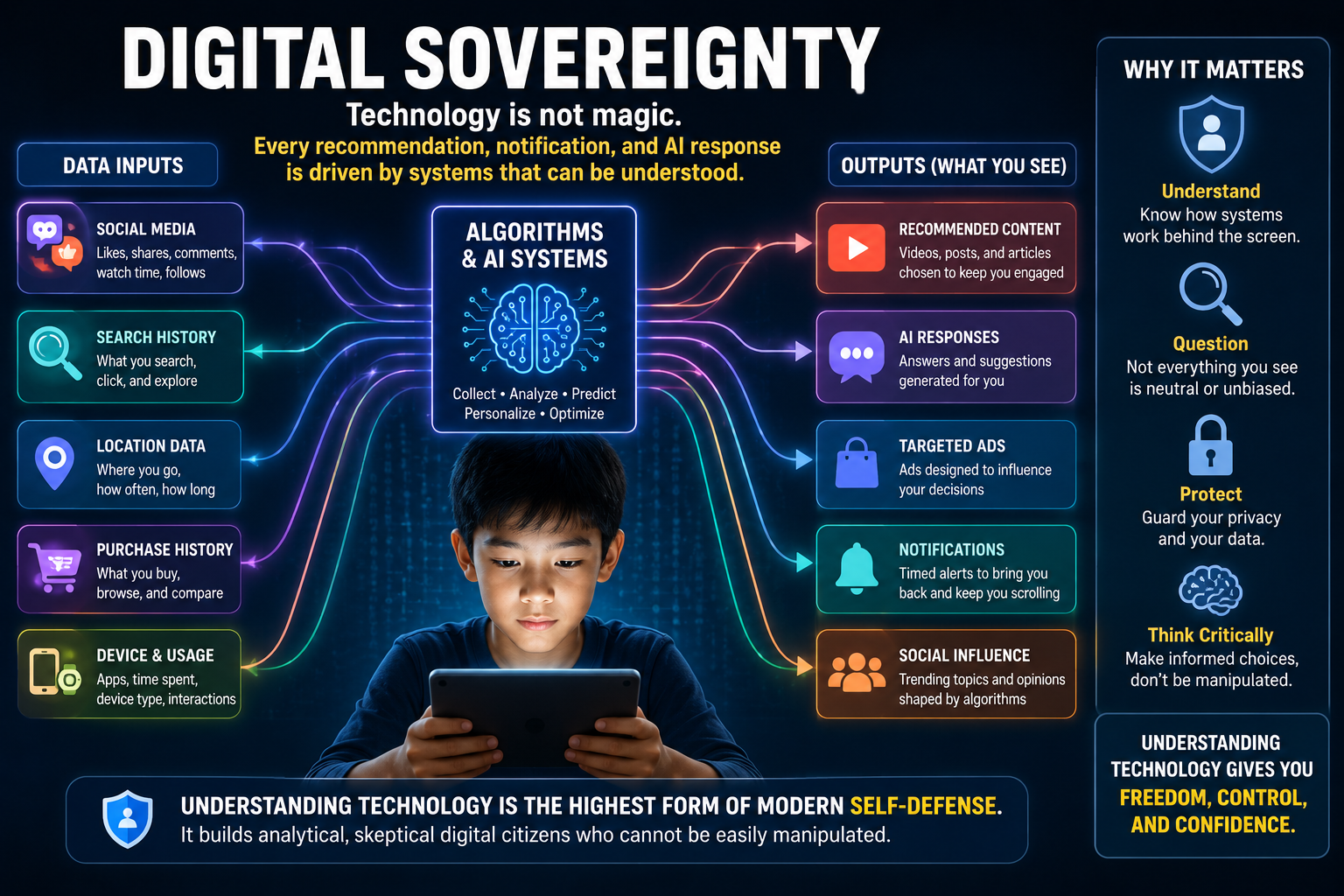
When children do not understand how technology works, they instinctively treat it like magic. This creates a highly dangerous dynamic:
They don't understand why a social media algorithm serves them specific, high-dopamine video feeds.
They don't understand how a Large Language Model (AI) mathematically synthesizes an answer, making them vulnerable to misinformation.
They don't understand how data tracking works, easily surrendering their digital privacy without a second thought.
This lack of fundamental structural knowledge breeds intense vulnerability. A child who understands basic computer science and network principles can look at a screen critically. When they open an application, they don't just see a shiny interface they realize that a newsfeed is a highly calibrated mathematical sorting mechanism explicitly engineered to capture and monetize human attention. They recognize that artificial intelligence can hallucinate or perpetuate biases embedded in its training data.
🧠 The Ultimate Defense: Understanding technology is the absolute highest form of modern self-defense. It builds analytical, skeptical digital citizens who cannot be easily manipulated by targeted algorithms or predatory user-experience designs.
🧠 Cultivating True Digital Confidence
There is a profound psychological transformation that occurs when a child moves from someone who simply plays with gadgets to someone who understands the logic happening inside the device. It completely replaces fear and frustration with systematic curiosity.
When a standard user encounters a software crash, a glitchy operating system, or an unfamiliar piece of enterprise software, their default reaction is helplessness or anger. When a tech-literate child faces the exact same situation, their internal monologue shifts to an exciting intellectual puzzle:
"What is the bottleneck here? Is this a logic error, a memory leak, or a network failure? Let's isolate it!"
That exact attitude digital confidence is an incredibly empowering mindset that stays with a child for the rest of their life. It instills a deep sense of agency, giving them the courage to confidently embrace radical technological change rather than run away from it.
🏫 Cultivating the Leaders of Tomorrow at True Coding School Phuket
At True Coding School Phuket, our educational philosophy extends far beyond training professional software engineers.
We look at coding not as an isolated technical skill, but as a dynamic medium to teach critical thinking, intellectual resilience, and creative execution. Through our specialized project-based curriculum, our students learn by conceptualizing, building, breaking, and fixing real-world applications.
We don't expect every single student who walks through our doors to graduate as a senior developer. But we do guarantee that they will leave our classrooms as sharp, articulate, and digitally confident individuals fully equipped with the mental architecture required to conquer whatever future they choose to build.
🚀 Want to prepare your child for the future?
At True Coding School Phuket, we provide the elite mentorship, creative environment, and professional tools required to transition students from absolute beginners into independent creators. Get in touch with us today to explore our project-based classes.
📋 Contact Information
Channel | Details |
📞 Phone | |
💬 Line |
|
📍 Address | 65/31 Moo 2, Chaofa-Suanluang Road, Vichit, Muang, Phuket 83000, Thailand |